
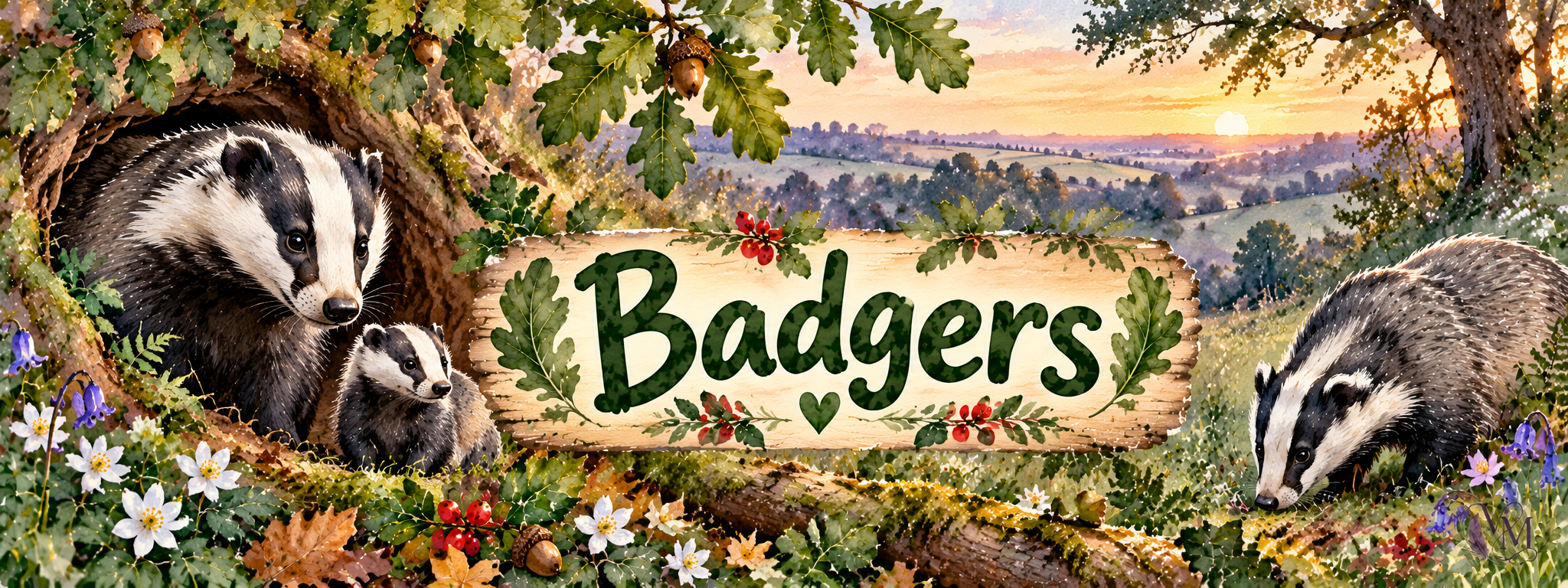
🦡 Badgers – Britain's Nocturnal Woodland Mammals
Discovering the European Badger
The European badger (Meles meles) is one of Britain's most recognisable wild mammals, known for its distinctive black-and-white striped face, powerful body and underground homes.
Badgers can be found in woodlands, farmland, hedgerows, grasslands and some gardens throughout much of Britain, although they are usually most active after sunset and during the night.
These fascinating mammals are strong diggers, skilled foragers and social animals, often living in family groups and creating complex underground tunnel systems known as setts.
Although badgers are frequently associated with woodland habitats and countryside landscapes, they can also live surprisingly close to towns, villages and residential areas.
During the colder winter months, badgers change their activity patterns to help them conserve energy and survive when food becomes harder to find.
🌿 What Does a Badger Look Like?
European badgers have strong, stocky bodies, short, powerful legs and a distinctive black-and-white striped face.
Their coats are generally grey across the back and sides, with darker fur on their legs and undersides.
The familiar facial markings include two dark stripes running from the nose towards the ears, separated by lighter areas of fur.
Adult European badgers typically measure approximately 75–100 centimetres in body length, with an additional short tail of around 15 centimetres.
Their weight varies with age, sex, season and food availability, but adults commonly weigh approximately 8–12 kilograms.
Badgers have strong front paws and long claws, which are specially adapted for digging tunnels, searching for food and moving soil.
Although they may appear slow or heavy, badgers are powerful animals capable of moving quickly when necessary.
🌙 Why Are Badgers Mostly Active at Night?
Badgers are primarily nocturnal mammals, meaning they are usually most active during the night.
They often leave their underground setts around dusk, spending the night searching for food, exploring their territories and interacting with other badgers.
Badgers have a particularly well-developed sense of smell, which helps them locate food, recognise other badgers and navigate their surroundings.
Their hearing is also important, while their eyesight is generally considered less developed than their senses of smell and hearing.
Although badgers are usually active after dark, they can sometimes be seen during daylight hours, particularly when food availability, seasonal conditions or local disturbances affect their behaviour.
Being nocturnal helps badgers explore their surroundings and forage, but it does not mean they are completely inactive during the day.
🏡 What Is a Badger Sett?
A badger sett is an underground home made from interconnected tunnels, entrances and sleeping chambers.
Badgers use their powerful front legs and strong claws to excavate soil, creating sheltered spaces beneath the ground.
Some setts are relatively small, while others develop into extensive underground networks that may be used and enlarged over many generations.
Badgers often line their sleeping chambers with dry grass, leaves, moss and other vegetation, helping create a comfortable resting environment.
They regularly replace old bedding with fresh vegetation, helping keep their underground sleeping chambers comfortable and relatively clean.
Badgers can carry bundles of grass, leaves and other materials back to their setts, sometimes moving backwards through the entrances while transporting their bedding.
A social group may use a main sett alongside smaller outlying setts, depending on territory size, habitat and local conditions.
🌟 Did You Know?
Some badger setts can remain in use for decades or even centuries, with successive generations maintaining and extending the underground tunnels.
However, not every sett is ancient or extensive, and the size and complexity of badger homes can vary considerably.
❄️ What Do Badgers Do During Winter?
Unlike hedgehogs, British badgers do not truly hibernate during the winter months.
Instead, they often become less active during periods of cold weather, spending longer resting underground in their sheltered setts.
Badgers may experience a form of winter torpor or lethargy, involving reduced activity and energy expenditure, which helps them conserve energy when food becomes scarce.
Their body temperature and metabolic activity may decrease, although these changes are generally less pronounced than those experienced by true hibernators.
During autumn, badgers may build up additional body fat, providing an important energy reserve for periods when food becomes scarce.
When conditions are suitable, badgers can still leave their setts to forage, even during December, January and February.
However, frozen ground, heavy snow and prolonged cold weather can make it more difficult to find earthworms and other natural foods.
Their underground setts provide shelter from wind, rain and freezing temperatures, helping them rest safely during harsh conditions.
🌟 Did You Know?
A badger might spend several days underground during particularly cold weather, but it can become active again when temperatures rise or feeding conditions improve.
This is why badgers are described as less active in winter, rather than as hibernating animals.
🪱 What Do Badgers Eat?
Badgers are omnivores, meaning they eat a mixture of animal and plant-based foods.
In Britain, earthworms are an especially important food source, although badgers also eat insects, grubs, fruits, berries, nuts, roots and other available foods.
They may occasionally eat small mammals, amphibians, birds' eggs or carrion, depending on local food availability and seasonal conditions.
Badgers use their sensitive noses and strong claws to locate and uncover food hidden beneath soil, leaves and vegetation.
During autumn, they may feed on fallen fruits, berries and other seasonal foods, helping them build energy reserves before winter.
Their diet changes throughout the year because different foods become available in different seasons.
Badgers are opportunistic foragers, meaning they make use of suitable food sources found within their territories.
👨👩👧👦 Do Badgers Live in Families?
European badgers are often social mammals, living in groups sometimes called clans.
A clan may include several adult badgers and their young, although group sizes and relationships vary between populations.
Badgers recognise one another through scent, behaviour and social interactions, helping them maintain relationships within their groups.
They use scent-marking to communicate and identify territorial boundaries and familiar individuals.
Badgers may share underground sleeping chambers and resting areas, particularly when living within established social groups.
However, not all badgers live in large clans, and some individuals may live alone or in smaller groups, depending on habitat, population density and food availability.
🐾 When Are Baby Badgers Born?
Baby badgers are called cubs, and most are born between January and March, with February being the most common month.
Female badgers usually give birth in underground nesting chambers, where the cubs remain warm, sheltered and dependent on their mother during their earliest weeks.
Newborn cubs are very small, helpless and dependent on their mother, gradually developing their fur, eyesight and ability to move independently.
Badger cubs generally begin emerging from their setts during spring, often around April or May, although the timing varies.
Young badgers spend time playing, exploring and learning important survival behaviours, including foraging and recognising their surroundings.
Badgers have an unusual reproductive adaptation called delayed implantation, which allows a fertilised embryo to remain temporarily suspended in development before implantation.
This helps explain why badger cubs are generally born during a similar seasonal period, even when mating has occurred at different times of the year.
🌟 Did You Know?
While badgers are spending more time resting underground during winter, female badgers may also be preparing for the arrival of their cubs.
Thanks to delayed implantation, embryos commonly implant around December or January, allowing most cubs to be born in late winter and emerge during spring.
This means that winter can be an important period for badger reproduction and development, even when the animals appear less active above ground.
🌳 Why Are Badgers Important?
Badgers play an important role in British woodlands, grasslands and wider ecosystems, contributing to soil movement, food webs and natural habitat processes.
Badgers are sometimes described as ecosystem engineers, meaning their digging, foraging and sett-building activities physically change their surroundings.
These activities can influence soil conditions, plant growth and habitats used by other wildlife, making badgers an important part of healthy and diverse ecosystems.
Their digging and foraging activities can disturb and loosen soil, influencing soil structure and the distribution of organic materials.
When badgers eat fruits and berries, they may help disperse seeds through their droppings, supporting plant growth and regeneration.
Their setts and digging activities can also create small habitat features, which may sometimes be used by other wildlife species.
Badgers are part of complex food webs, interacting with plants, invertebrates, mammals and other organisms within their habitats.
Protecting woodlands, hedgerows, grasslands and connected wildlife corridors helps badgers access food, shelter and suitable territories.
⚖️ Are Badgers Protected in the UK?
Badgers and their setts receive legal protection throughout the United Kingdom, although the specific legislation and permitted activities differ between nations.
In England, Wales and Scotland, the Protection of Badgers Act 1992, as amended, provides protection against offences such as unlawfully killing, injuring or taking badgers, and damaging, destroying or interfering with protected setts.
In Northern Ireland, badgers receive protection under separate wildlife legislation, including the Wildlife (Northern Ireland) Order 1985, as amended.
Certain activities may be permitted under specific legal exemptions or licences, so anyone planning work near a sett should seek appropriate guidance before proceeding.
Because badger setts may remain in use for many years, it is important to avoid disturbing entrances, digging near tunnels or interfering with bedding materials.
Badgers are wild animals and should be observed from a respectful distance, without attempting to touch, handle or enter their underground homes.
🔍 Badger Facts to Remember
🦡 Scientific name: Meles meles.
🌍 Where they live: Woodlands, farmland, grasslands, hedgerows and some urban areas.
🎨 Appearance: Grey body, dark legs and a distinctive black-and-white striped face.
📏 Size: Approximately 75–100 cm in body length, excluding the tail.
⚖️ Weight: Commonly around 8–12 kg, depending on the individual and season.
🌙 Activity: Primarily nocturnal, although daytime activity is possible.
🏡 Home: Underground tunnels and chambers called setts.
🪱 Diet: Earthworms, insects, fruits, berries and other available foods.
❄️ Winter behaviour: Reduced activity and possible winter torpor, but no true hibernation.
👨👩👧👦 Social groups: Often lives in family groups known as clans.
🐾 Young: Baby badgers are called cubs, usually born between January and March.
🌿 Ecological role: Digging, soil disturbance, seed dispersal and habitat modification.
⚖️ Conservation: Badgers and their setts are legally protected throughout the UK.
💚 Exploring Badgers Through Inclusive Learning
Learning about badgers offers opportunities for wildlife discovery, seasonal exploration and sensory-friendly activities suitable for children with different interests, abilities and learning needs.
Children can explore the topic through photographs, illustrations, storytelling, creative activities and habitat investigations, without needing to encounter wild badgers or visit their setts.
Some children may enjoy building pretend underground tunnels, while others prefer drawing, sorting natural materials, listening to stories or investigating animal tracks.
Activities can be adapted to support different communication styles, sensory preferences, physical abilities and developmental stages, ensuring children can participate in ways that feel comfortable and meaningful.
Because badgers are mainly active at night, children do not need to stay awake after dark or visit woodland habitats at night to learn about their behaviour and natural environments.
The aim is to encourage curiosity, understanding and respect for wildlife, while helping children develop an appreciation of Britain's natural habitats.
🌿 Explore Our Badger Resources
Discover a growing collection of free educational activities, creative resources and inclusive learning opportunities inspired by the European badger and its place in British nature.
From woodland habitats and underground sett investigations to winter survival, animal identification and creative exploration, our resources encourage children to observe, discover and learn at their own pace.
Every child deserves the opportunity to explore nature in a way that works for them.