
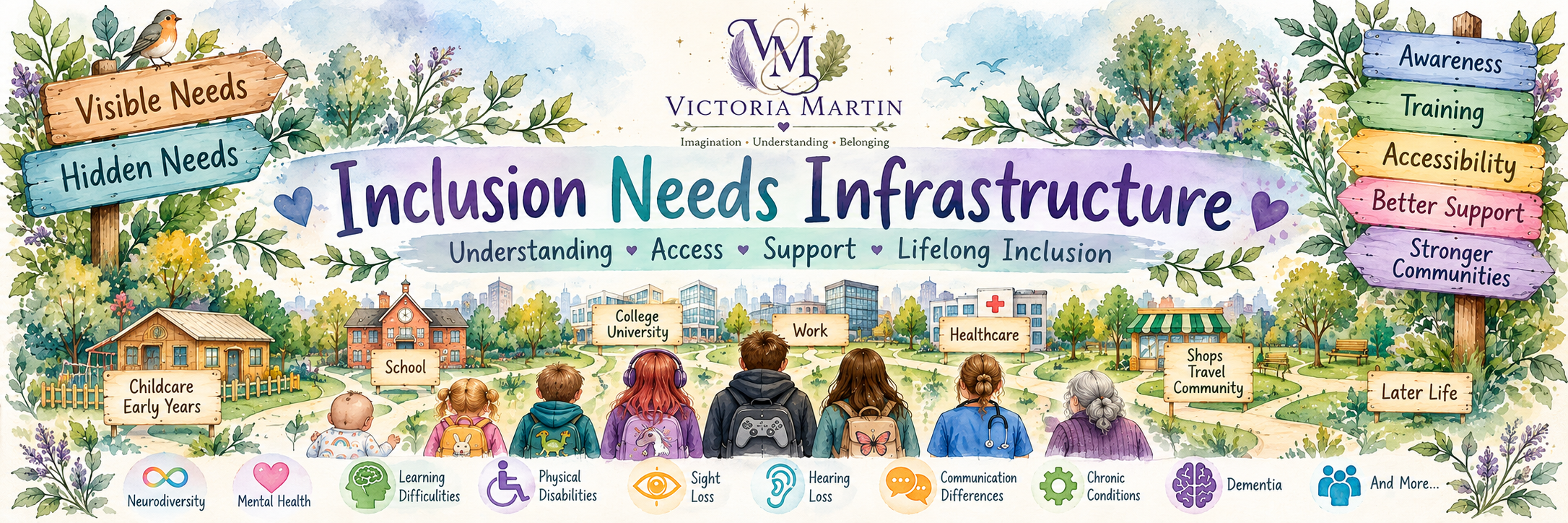
💜 Inclusion Needs Infrastructure
Visible Needs. Hidden Needs. Lifelong Inclusion.
Inclusion Needs Infrastructure is a UK-wide campaign advocating for improvements in inclusion, professional education, practical experience, accessibility and support for people with visible and hidden disabilities, neurodivergence, mental health difficulties and additional needs throughout every stage of life.
The campaign focuses on three interconnected areas: Early Years and Education, Health and Care, and Community Inclusion, recognising that meaningful inclusion requires appropriate training, resources, understanding and support for both individuals and the professionals working with them.
💜 The Campaign Aims To:
🎓 Strengthen professional education by advocating for appropriate, mandatory inclusion training within relevant qualifications in early years, education, healthcare, social care and other professions, building upon existing training requirements and professional standards.
🧩 Improve practical experience by proposing a minimum of one working shift of supervised, inclusion-focused practical experience, with 12 hours recommended where appropriate or possible, within suitable specialist or additional-support environments as part of relevant professional qualifications. Existing equivalent experience should be recognised.
🤝 Support professionals and organisations by identifying gaps in training, resources, guidance and practical support that may affect their ability to provide inclusive education, care and services.
🚨 Strengthen understanding in public-facing services by advocating for appropriate additional or refresher training, where needed, in areas such as policing, transport and emergency response, including practical understanding of dementia, learning disabilities, neurodivergence and communication needs.
🌍 Promote lifelong inclusion across early years, education, healthcare, social care, employment, shops, transport, leisure and everyday community life, recognising that support and accessibility remain important throughout adulthood and later life.
💜 Improve awareness and accessibility by increasing understanding of visible and hidden needs, challenging misconceptions and encouraging respectful communication, appropriate flexibility and reasonable adjustments in accordance with applicable legislation.
📊 Gather experiences and evidence from individuals, families, carers, professionals and organisations across England, Scotland, Wales and Northern Ireland, recognising existing good practice, identifying barriers and advocating for practical, evidence-informed improvements.
The campaign recognises that legislation, training requirements and professional responsibilities already exist and differ across the four UK nations. Its proposals aim to strengthen existing provision where improvements are needed, rather than replace established good practice.
💜 Our Goal
To make inclusion part of the foundations of everyday society, rather than an afterthought.
Because inclusion doesn't stop at 25, doesn't belong to one diagnosis and shouldn't depend on someone having to fight to be understood. 💜


Can you help the campaign? We need information and evidence. Please take the time to fill out the questionnaire relevant to you, and help give our friends and family the help and support they deserve, whether through employment support and training or support and care for themselves.
Early Years — Supporting Children With Additional Needs – Fill in form
Healthcare — Hidden Disabilities and Inclusive Care – Fill in form
Public Experiences of Community Inclusion – Fill in form
What Happens to Your Responses?
The information gathered through our surveys will help identify gaps in professional training, accessibility and support. Findings will be analysed to highlight common experiences and inform future campaign proposals, recommendations and discussions with relevant organisations, training providers and policymakers.
Participation is completely anonymous, and no personal or contact details will be asked