
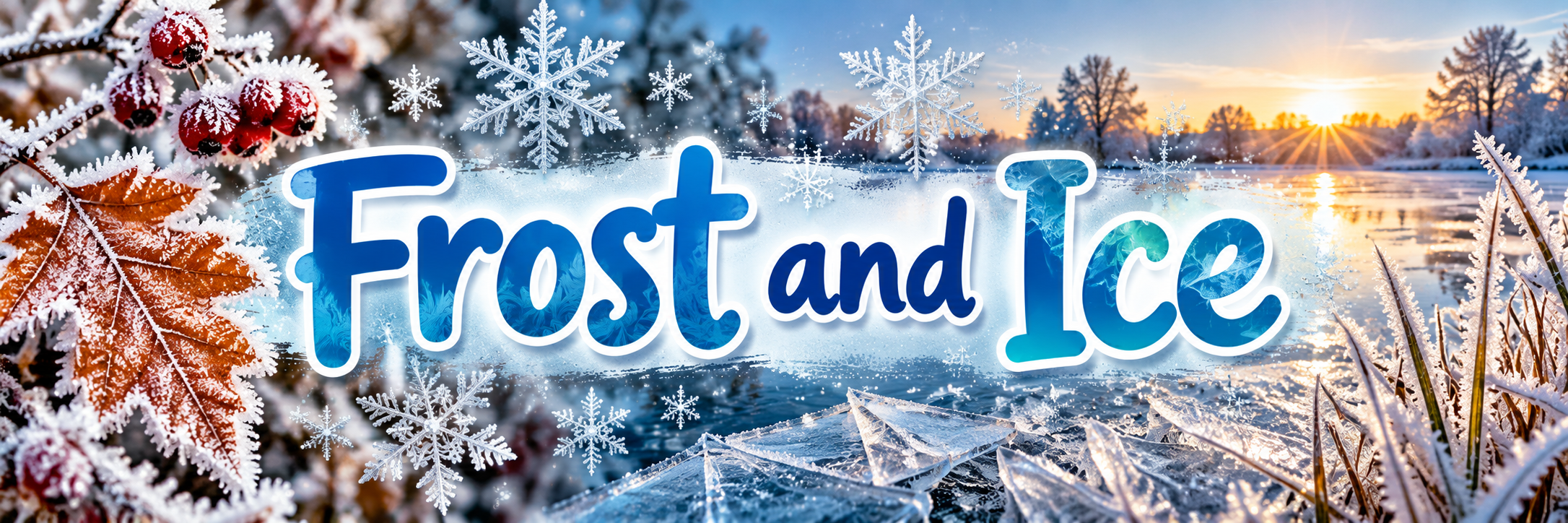
❄️ Frost and Ice – Discovering Winter's Frozen World
January Mid-Month Environmental Highlight
🌨️ Welcome to the World of Frost and Ice!
On a cold winter morning, the world can look completely different.
Grass sparkles with tiny crystals, leaves are edged with white, and puddles become sheets of ice. Sometimes, even windows and fences appear to be covered in delicate, frozen patterns.
These beautiful winter changes are caused by frost and ice, two natural features that appear when temperatures become cold enough.
Although frost and ice are closely connected, they do not always form in the same way.
Hoar frost develops when water vapour in the air changes directly into ice crystals on a sufficiently cold surface, while ordinary ice can form when liquid water freezes.
Other frozen deposits, such as frozen dew and rime ice, develop through slightly different processes.
All these frozen wonders are connected to the water cycle, helping us understand how water changes between gas, liquid and solid.
During January, frost and ice can be found across the UK, particularly on clear, calm nights when the ground loses heat.
Let's explore the fascinating science behind these frozen wonders!
💧 What Happens When Water Freezes?
Water exists naturally in three different states:
💧 Liquid: The water we drink, the rain that falls and the water flowing through rivers.
☁️ Gas: Water vapour, an invisible gas found in the air.
🧊 Solid: Ice, snow and frost.
When liquid water becomes cold enough, it can change into solid ice.
Under normal atmospheric pressure, pure water usually freezes at approximately 0°C (zero degrees Celsius).
As water cools, its molecules generally move more slowly. When it freezes, they arrange themselves into an ordered crystal structure.
Interestingly, water expands as it freezes.
This happens because the structure of ordinary ice takes up more space than the same amount of liquid water.
It is also why ice is less dense than liquid water, allowing it to float on the surface.
🌟 Did You Know?
🧊 Ice takes up approximately 9% more space than the liquid water it forms from!
This expansion can sometimes cause water-filled containers to crack or water pipes to burst during freezing weather.
❄️ What Is Frost?
Frost is a covering of tiny ice crystals that forms on cold surfaces.
You might discover frost on grass, leaves, rooftops, fences, cars and windows.
One common type, called hoar frost, forms when water vapour in the air changes directly into ice on a surface that is sufficiently cold.
This process is called deposition.
Unlike ordinary freezing, deposition allows water to change from gas directly into solid ice, without becoming liquid first.
The crystals can grow into delicate shapes that resemble feathers, needles or tiny branches.
Frost is particularly common on clear, calm nights, when surfaces lose heat into the atmosphere.
Sometimes, the ground and nearby objects become colder than the surrounding air.
This means frost can form even when the official air temperature, measured above the ground, is slightly above 0°C.
However, freezing temperatures do not always produce visible white frost.
There must also be sufficient moisture available for ice crystals to develop.
🌟 Did You Know?
🌡️ Ground frost and air frost are not the same thing!
Ground frost occurs when the temperature at the ground surface falls below 0°C.
Air frost occurs when the air temperature falls to 0°C or below, measured at the standard weather observation height.
In the UK, the Met Office measures standard air temperatures at approximately 1.25 metres above the ground.
This explains why you might discover frost-covered grass even when the weather forecast reports an air temperature just above freezing.
🔍 Are There Different Types of Frost?
Not all frost looks the same, and different conditions can produce different frozen patterns.
Frost and frost-like ice deposits can form in several different ways.
❄️ Hoar Frost
Hoar frost forms when water vapour deposits directly as ice crystals on a sufficiently cold surface.
It can create beautiful feathery, spiky or branching patterns.
You might notice it on grass, branches, fences and other exposed surfaces.
🌫️ Rime Ice
Rime ice forms when tiny supercooled water droplets, often found in fog or cloud, freeze when they touch a surface.
Supercooled droplets are liquid water droplets that remain unfrozen below 0°C.
Rime often appears as a rough, white or cloudy coating.
It is particularly common in freezing fog and on exposed objects in upland areas.
Unlike hoar frost, rime forms from liquid droplets freezing on contact, rather than water vapour depositing directly as ice.
🌱 Frozen Dew
Sometimes, dew forms on a surface first, before the temperature falls below freezing.
If the dew then freezes, it creates a thin layer of ice.
Although this may look similar to hoar frost, it forms through a different process.
Hoar frost forms directly from water vapour, while frozen dew begins as liquid water droplets.
🌟 Did You Know?
❄️ Frost crystals can form different shapes depending on temperature, moisture and growing conditions.
Some appear as tiny needles, while others resemble feathers, plates or delicate branches.
🧊 How Does Ice Form on Puddles and Ponds?
Have you ever discovered a puddle that has frozen overnight?
When temperatures fall sufficiently, heat leaves the water, allowing ice to begin forming.
In a shallow puddle, the water may freeze almost completely.
Larger bodies of water, such as ponds and lakes, behave differently.
Water is unusual because it becomes most dense at approximately 4°C.
As the surface water cools towards this temperature, it becomes denser and can sink.
However, when water cools below approximately 4°C, it becomes less dense and tends to remain nearer the surface.
When the surface reaches freezing conditions, ice begins to form on top.
Because ice floats, it creates a layer that can help slow further heat loss from the water beneath.
This means that even when the surface of a pond freezes, liquid water may remain underneath.
This is extremely important for fish, aquatic insects and other pond wildlife.
🌊 Do All Ponds Freeze in the Same Way?
Not necessarily!
The explanation above describes how freshwater generally behaves in calm conditions.
In natural ponds and lakes, water depth, wind, currents and dissolved substances can influence how quickly ice forms.
A shallow pond may freeze completely during prolonged periods of very cold weather.
A deeper pond may retain liquid water beneath the surface for much longer.
The presence of surface ice can help slow heat loss, but it does not guarantee that the water beneath will remain suitable for wildlife.
🌟 Did You Know?
🐟 A frozen pond is not necessarily frozen all the way through!
The layer of ice on the surface can help protect liquid water underneath, allowing some aquatic animals to survive the winter.
However, ice thickness can vary greatly, making frozen ponds and lakes dangerous to walk on.
🌿 What Happens to Plants During Frost?
Frost can make plants look beautiful, but freezing temperatures can also affect their survival.
When water inside or around plant cells freezes, ice crystals may damage delicate tissues.
Some plants are particularly vulnerable, especially those adapted to warmer climates.
However, many plants found in the UK have developed ways to survive cold winter conditions.
🌳 Trees and Shrubs
Many deciduous trees lose their leaves during autumn and enter a period of winter dormancy.
This helps them reduce water loss and conserve resources during colder months.
Their buds remain protected until conditions become suitable for new growth.
🌲 Evergreen Plants
Evergreen plants, including holly, ivy and many conifers, keep their leaves throughout winter.
Some have waxy coatings, tough leaves or other adaptations that help reduce water loss and withstand cold conditions.
🌱 Frost-Hardy Plants
Some plants can survive freezing temperatures by changing the composition of fluids within their cells.
They may accumulate sugars and other substances that help protect their tissues from freezing damage.
These adaptations do not make every plant completely frost-proof, but they can improve cold tolerance and winter survival.
🌟 Did You Know?
🌿 Some plants can survive temperatures well below 0°C, while others may suffer damage after only a short period of frost.
A plant's ability to tolerate freezing depends on its species, growing conditions and how well it has adapted to colder weather.
🦊 How Does Frost and Ice Affect Wildlife?
Cold weather creates challenges for animals, particularly when food and water become harder to find.
However, British wildlife has developed a range of behavioural and physical adaptations to help survive winter.
🦊 Foxes
Foxes remain active throughout winter.
Their thick winter coats help provide insulation, while their ability to eat a wide variety of foods helps them survive when certain prey becomes scarce.
They may travel across frosty fields, woodland paths and gardens while searching for food.
🦡 Badgers
Badgers do not undergo true hibernation.
During particularly cold weather, they may spend longer periods resting inside their underground setts.
Their activity levels can decrease, especially when frozen ground makes earthworms difficult to find.
🐦 Garden Birds
Small birds face particular challenges during freezing weather because they need regular food to maintain their body temperature.
Many birds fluff up their feathers, trapping small pockets of insulating air close to their bodies.
Some species also develop denser winter plumage, including additional soft, downy feathers.
Together, these adaptations help birds reduce heat loss and survive colder temperatures.
Some birds gather in sheltered places to reduce exposure to cold winds.
Providing suitable bird food and clean, unfrozen drinking water can help garden birds during cold weather.
🦔 Hedgehogs
Hedgehogs usually spend much of winter in hibernation, although they may occasionally wake or move between nesting sites.
Their bodies reduce heart rate, breathing and energy use to conserve stored fat.
A suitable winter nest provides protection from cold, wet weather and disturbance.
🐸 Frogs and Other Pond Animals
Some frogs spend winter sheltering in mud, beneath vegetation or underwater, depending on the species and conditions.
They can survive with greatly reduced activity and metabolism.
Common frogs are also capable of absorbing dissolved oxygen through their skin while underwater.
This helps explain how some frogs can survive beneath the surface of a pond during winter.
However, frogs still need sufficient dissolved oxygen to survive.
If a pond remains frozen for a prolonged period, oxygen levels may fall, particularly in shallow ponds containing decaying vegetation.
This means that frozen ponds do not always provide safe winter habitats for amphibians.
🌟 Did You Know?
🐦 Birds have several ways to stay warm during winter!
Many birds fluff up their feathers to trap insulating air.
Some species also develop denser winter plumage, while others seek sheltered places to rest.
These adaptations help birds conserve energy and reduce heat loss during freezing weather.
🌍 Why Are Frost and Ice Important?
Frost and ice are more than beautiful winter decorations.
They influence soil, plants, wildlife, water systems and the wider environment.
🌱 Frost and the Soil
When water inside soil freezes, it can expand and contribute to frost heave.
This process may cause soil particles and small stones to move upwards or shift position.
Repeated freezing and thawing can also help break apart some rocks and soil structures.
🪨 Freeze–Thaw Weathering
Water can enter small cracks in rocks.
When it freezes, its expansion can contribute to widening those cracks.
Repeated freezing and thawing may eventually cause pieces of rock to break away.
This process is known as freeze–thaw weathering.
It is particularly important in environments where temperatures regularly rise above and fall below freezing.
💧 The Water Cycle
Ice is part of the natural water cycle.
When temperatures rise, frost and ice melt, returning water to its liquid state.
This water may then flow into the soil, collect in puddles or enter rivers and streams.
🐟 Frozen Habitats
Surface ice on ponds and lakes can help slow heat loss, allowing some aquatic life to survive beneath it.
However, prolonged ice cover can also affect oxygen levels and light reaching the water, particularly in shallow ponds.
🌡️ Weather and Climate
Frost is influenced by temperature, moisture, cloud cover and wind conditions.
As the climate changes, the frequency, timing and duration of frosty conditions may also change.
Although the UK can still experience very cold spells, long-term warming is affecting winter temperatures and seasonal patterns.
🔍 Why Does Some Ice Look Clear and Other Ice Look White?
Have you ever noticed that some ice looks almost transparent, while other ice appears white, cloudy or milky?
This difference is connected to how light travels through the ice.
Pure ice can appear clear or transparent because visible light can pass through it.
However, tiny air bubbles, cracks and other irregularities can scatter light in different directions.
When lots of light is scattered, the ice can appear white or cloudy.
This helps explain why some frozen puddles look clear, while others have a milky or frosted appearance.
The appearance of ice can also depend on how it formed, how quickly it froze and what substances were present in the water.
🌟 Did You Know?
🧊 Clear ice and cloudy ice are both frozen water!
The difference in appearance is often caused by tiny bubbles, cracks or other features inside the ice that affect how light passes through it.
⚠️ Staying Safe Around Frost and Ice
Frost and ice can be fascinating to explore, but winter conditions also create hazards.
Frozen surfaces may be extremely slippery, particularly on paths, steps and roads.
Ice on ponds, lakes and rivers can be unpredictable and dangerous, even when it looks thick enough to stand on.
Remember:
❄️ Walk carefully on icy paths and wear suitable footwear.
🧤 Dress warmly, using layers, gloves and appropriate outdoor clothing.
🧊 Never walk onto frozen ponds, lakes or rivers, even if the surface appears solid.
👀 Observe frost and ice from safe locations, rather than climbing onto slippery surfaces.
💧 Avoid tasting or eating outdoor ice, as it may contain dirt, chemicals or other contaminants.
👨👩👧 Children should be supervised when exploring icy environments.
If someone falls through ice, do not enter the water to rescue them. Call 999 and follow emergency service instructions.
Winter exploration should always prioritise safety, comfort and individual needs.
🌟 Fascinating Frost and Ice Facts!
❄️ Frost can form without rain or snow! Water vapour in the air can turn directly into ice crystals on a sufficiently cold surface.
🧊 Ice floats because it is less dense than liquid water. This unusual property helps protect aquatic habitats during winter.
🌡️ Frost can form when the forecast air temperature is above 0°C, because the ground may be colder than the air measured above it.
💧 Water expands by approximately 9% when it freezes, which can cause damage to pipes and containers.
🌿 Some plants produce natural protective substances that help their cells survive freezing conditions.
🐦 Birds can fluff up their feathers and develop denser winter plumage to help reduce heat loss.
🌫️ Rime ice forms when supercooled water droplets freeze on contact, often during freezing fog.
🐟 Fish can survive beneath frozen pond surfaces when suitable liquid water and oxygen remain available.
🌍 Frost and ice are part of Earth's water cycle, connecting winter weather with the movement of water through the environment.
🔍 Ice crystals can grow into many different shapes, depending on the conditions in which they form.
🧊 Some ice is almost completely transparent, while tiny bubbles and cracks can make other ice appear white or cloudy.
🪨 Freezing water can help break rocks apart through a process called freeze–thaw weathering.
❄️ Visible frost does not always mean the air temperature is below freezing, because surfaces can become colder than the surrounding air.
🎨 Explore Frost and Ice Through Play and Learning
Frost and ice offer wonderful opportunities for hands-on discovery, sensory exploration, scientific investigation and creative learning.
Children can explore the winter environment through activities adapted to their individual interests, developmental stages and sensory preferences.
🔍 Become a Frost Detective
Explore a garden, school playground or local outdoor space on a frosty morning.
Look for frost-covered leaves, sparkling grass, icy puddles and frozen patterns.
Children can observe, photograph, draw or describe what they discover.
🧊 Investigate Melting Ice
Place small ice cubes in shallow trays and observe how quickly they melt.
Try comparing ice placed in sunlight, shade or a warm indoor environment.
Encourage children to predict, observe and compare what happens.
🎨 Create Frost-Inspired Artwork
Use white crayons, pale blue paint, paper snowflakes or textured materials to create pictures inspired by frost.
Children can explore shapes, patterns and colours without needing to touch real ice.
💧 Explore Freezing and Melting
With adult support, place water in a freezer-safe container and observe how it changes.
Children can explore the difference between liquid water and solid ice.
Discuss what happens when the ice is allowed to warm and melt.
🐾 Discover Winter Wildlife
Investigate how British birds, mammals and pond animals survive freezing weather.
Children can create wildlife fact cards, winter habitat pictures or simple food-chain activities.
🌈 Different Ways to Participate
Not every child enjoys cold temperatures, wet textures or direct contact with ice.
Activities can be adapted using photographs, videos, visual instructions, sensory tools, gloves or alternative materials.
Children may prefer to watch rather than touch, explore from indoors, or take part through discussion, movement, creative expression or independent observation.
Meaningful participation does not require direct sensory contact, spoken responses or completing an activity in a particular way.
💙 Discover the Beauty of Winter
Frost and ice reveal a fascinating side of the natural world.
From delicate crystals on leaves to frozen ponds and sparkling winter landscapes, these seasonal changes help us understand temperature, water, wildlife and the environment.
By exploring frost and ice, children can develop scientific curiosity, observation skills and an appreciation of the changing seasons.
Whether discovering frosty patterns outdoors, experimenting with melting ice indoors, or learning about animals surviving winter, there are many ways to experience the wonders of the colder months.
Every child deserves the opportunity to explore nature in a way that works for them.