
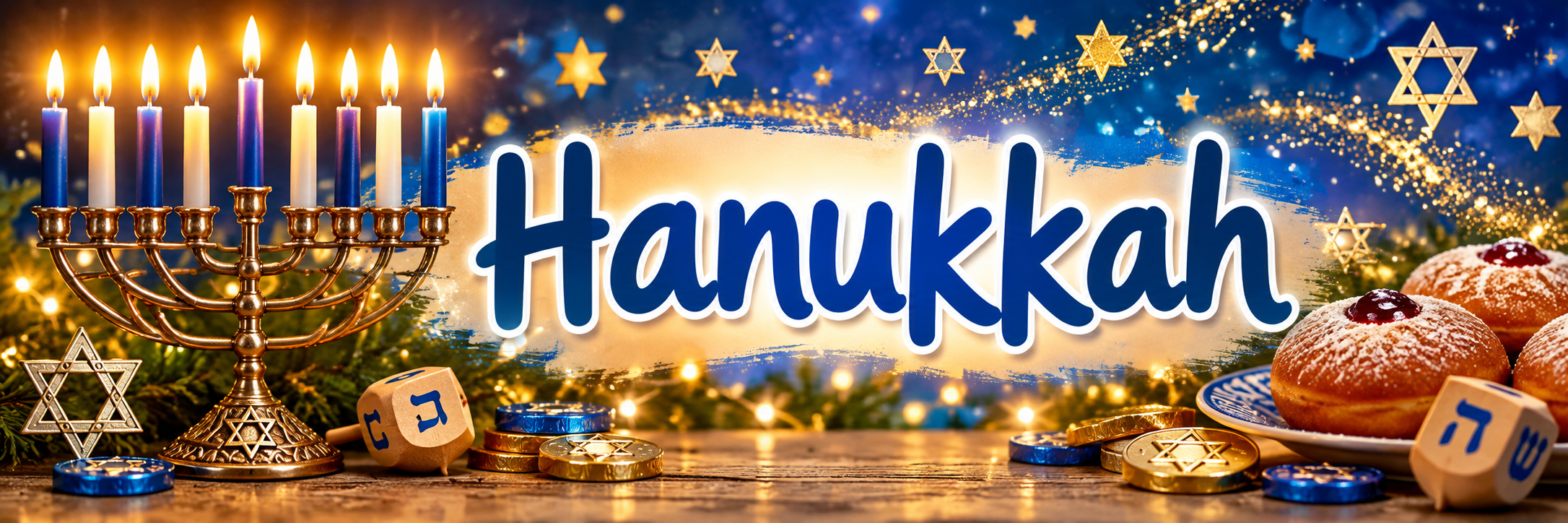
🕎 Hanukkah – The Jewish Festival of Lights
✨ What Is Hanukkah?
Hanukkah, also known as the Festival of Lights, is an important Jewish celebration that lasts for eight nights and days.
The festival commemorates the rededication of the Second Temple in Jerusalem following the Maccabean revolt more than 2,000 years ago.
Hanukkah celebrates Jewish religious dedication, perseverance and the preservation of Jewish traditions, with the lighting of a special Hanukkah lamp playing a central role.
Today, Hanukkah is celebrated by Jewish communities around the world, with families coming together to light candles, share traditional foods, play games and remember the festival's history.
Although Hanukkah often takes place during November or December, its dates change each year because it follows the Jewish calendar, which is different from the calendar commonly used in Britain.
📅 In 2026, Hanukkah begins at sunset on Friday 4 December and ends after nightfall on Saturday 12 December.
📖 The Story Behind Hanukkah
The story of Hanukkah begins more than 2,000 years ago, during a period when the Jewish people faced religious persecution and restrictions on their traditions.
At the time, the region was ruled by the Seleucid Empire, under King Antiochus IV.
Jewish religious practices were restricted, and the Temple in Jerusalem, an important place of Jewish worship, was desecrated.
A group of Jewish fighters, known as the Maccabees, led a revolt against the Seleucid authorities.
Following their success, the Jewish people were able to reclaim the Temple in Jerusalem.
The Temple was cleaned, restored and rededicated, allowing Jewish worship to resume.
This rededication took place in approximately 164 BCE, more than 2,100 years ago.
🕯️ The Miracle of the Oil
According to Jewish religious tradition, when the Temple was rededicated, there was only enough ritually pure oil to keep its sacred lamp burning for one day.
However, the oil is said to have miraculously lasted for eight days, allowing time for more suitable oil to be prepared.
This became known as the miracle of the oil and is an important part of the religious traditions associated with Hanukkah.
The Maccabean revolt and rededication of the Temple are described in ancient historical accounts, including the Books of Maccabees.
The famous story of the oil lasting for eight days appears in later Jewish religious writings, particularly the Talmud.
Both accounts help explain Hanukkah's history, religious meaning and traditions.
Today, the festival remembers the rededication of the Temple, the preservation of Jewish religious practices and the traditional miracle of the oil.
🕯️ Why Are Candles Lit During Hanukkah?
One of the most recognisable Hanukkah traditions is the lighting of a special nine-branched candleholder called a hanukkiah.
The hanukkiah has eight places for the festival lights, representing the eight nights of Hanukkah.
A ninth place holds the shamash, meaning helper or attendant, which is traditionally used to light the other candles.
On the first night, one festival light is kindled.
Each following night, an additional light is added, until all eight festival lights are lit on the final night.
Many families say special blessings and prayers during the candle-lighting ceremony, while others may also sing traditional songs.
Hanukkah lights are generally kindled during the evening, although the precise timing depends on Jewish religious customs and the day of the week.
When Hanukkah coincides with Shabbat, the Jewish Sabbath, special rules determine when the lights are kindled.
For example, on Friday evenings, Hanukkah lights are kindled before Shabbat begins, while on Saturday evenings, they are kindled after Shabbat has ended.
The glowing lights help remember Hanukkah's history, religious traditions and the miracle of the oil.
🌟 Did You Know?
Although people sometimes call a Hanukkah candleholder a menorah, the more specific name for the nine-branched Hanukkah lamp is hanukkiah.
The traditional seven-branched menorah is a different Jewish religious symbol, historically associated with the Temple in Jerusalem.
🎲 What Is a Dreidel?
A dreidel is a traditional four-sided spinning top used in a game often played during Hanukkah.
Each side of the dreidel displays a Hebrew letter.
The letters are traditionally associated with a phrase remembering the Hanukkah miracle, while also helping determine what happens during the game.
Depending on the letter, a player may take counters, add counters or leave them unchanged.
Outside Israel, the four Hebrew letters are traditionally understood as representing the phrase:
“Nes Gadol Haya Sham” — “A great miracle happened there.”
In Israel, the final letter is commonly different, representing:
“Nes Gadol Haya Po” — “A great miracle happened here.”
Children and adults may play using counters, chocolate coins or other small objects.
Dreidel games provide an opportunity for families to spend time together, while also introducing children to Hebrew letters and Hanukkah traditions.
🌟 Did You Know?
The dreidel is sometimes called a sevivon in Hebrew.
The word is connected to the Hebrew verb meaning “to spin”, reflecting how the traditional game is played.
🥔 Traditional Hanukkah Foods
Food is an important part of many Hanukkah celebrations, particularly dishes prepared using oil.
These foods help remember the traditional story of the oil lasting for eight days.
Two familiar Hanukkah foods are:
🥔 Latkes: Crispy potato pancakes, traditionally fried in oil and often served with apple sauce or sour cream.
🍩 Sufganiyot: Soft doughnuts, usually filled with jam or other sweet fillings and often topped with icing sugar.
Different Jewish communities also prepare other traditional dishes, reflecting their cultural backgrounds, family recipes and regional customs.
For example, some families enjoy fried pastries, savoury dishes or other foods prepared using oil.
Not every family eats the same foods, and Hanukkah traditions can vary considerably around the world.
Sharing traditional meals can provide an opportunity for families to celebrate together, remember their heritage and pass recipes between generations.
💙 How Do Families Celebrate Hanukkah?
Hanukkah celebrations can include lighting the hanukkiah, saying blessings, singing songs, sharing meals and spending time with family and friends.
Some families exchange small gifts, while others give children gelt, which traditionally refers to money.
Today, Hanukkah gelt is also associated with chocolate coins wrapped in gold foil.
Children may enjoy playing dreidel, listening to stories and taking part in family traditions.
Some Jewish families also participate in community gatherings, religious services and charitable activities during the festival.
Hanukkah provides an opportunity to reflect on Jewish history, religious identity and the importance of preserving religious traditions.
Although Hanukkah is sometimes compared with Christmas because the celebrations can occur around the same time, they are separate festivals with different religious meanings and traditions.
Hanukkah is not the Jewish equivalent of Christmas.
It has its own history, religious significance and traditional celebrations.
🌟 Did You Know?
Hanukkah is celebrated by Jewish families across many countries, but celebrations are not identical everywhere.
Different families may have their own songs, foods, customs and ways of celebrating, reflecting the diversity of Jewish cultures and traditions.
Some families may celebrate with large gatherings and community events, while others prefer quieter celebrations at home.
🌟 Interesting Hanukkah Facts
🕎 Hanukkah means “dedication” in Hebrew, referring to the rededication of the Temple in Jerusalem.
🕯️ The festival lasts for eight nights and days, with an additional festival light kindled each night.
🎲 Dreidels are four-sided spinning tops featuring Hebrew letters.
🥔 Foods cooked in oil, including latkes and sufganiyot, are associated with the traditional miracle of the oil.
📅 Hanukkah begins on the 25th day of Kislev in the Jewish calendar, meaning its dates vary on the calendar commonly used in Britain.
💙 Hanukkah celebrates Jewish history, religious dedication and the preservation of traditions.
✍️ Hanukkah has several accepted English spellings, including Hanukkah, Chanukah and Hanukah. These variations exist because the original Hebrew word uses a different alphabet, and its sounds can be represented in English in different ways.
📖 Hanukkah is not mentioned in the Torah, the first five books of the Hebrew Bible. Unlike some other Jewish festivals, Hanukkah developed from events during the Second Temple period and later Jewish religious traditions.
🕎 A traditional hanukkiah has nine places for lights, while the ancient Temple menorah had seven branches.
🌍 Jewish communities celebrate Hanukkah around the world, with traditions that reflect different cultures, countries and family histories.
🎨 Explore Our Hanukkah Resources
Discover our collection of educational activities, creative resources and inclusive learning opportunities designed to help children explore Hanukkah and its traditions.
Through colouring activities, creative projects, games, stories and cultural learning, children can discover the meaning behind the Festival of Lights while developing curiosity, understanding and respect for different beliefs.
Our resources are designed to support different learning styles, communication preferences, sensory needs and developmental stages, allowing children to participate in ways that feel comfortable and meaningful.
Children might enjoy exploring colours and patterns, learning about traditional symbols, investigating light and shadow or discovering how different families celebrate.
Activities can be adapted for children who prefer hands-on exploration, visual learning, movement, structured tasks or quieter sensory experiences.
Whether children are celebrating Hanukkah with their families or learning about the festival for the first time, our aim is to encourage respectful exploration, cultural awareness and inclusive learning.
Every child deserves the opportunity to learn, explore and celebrate in a way that works for them.