
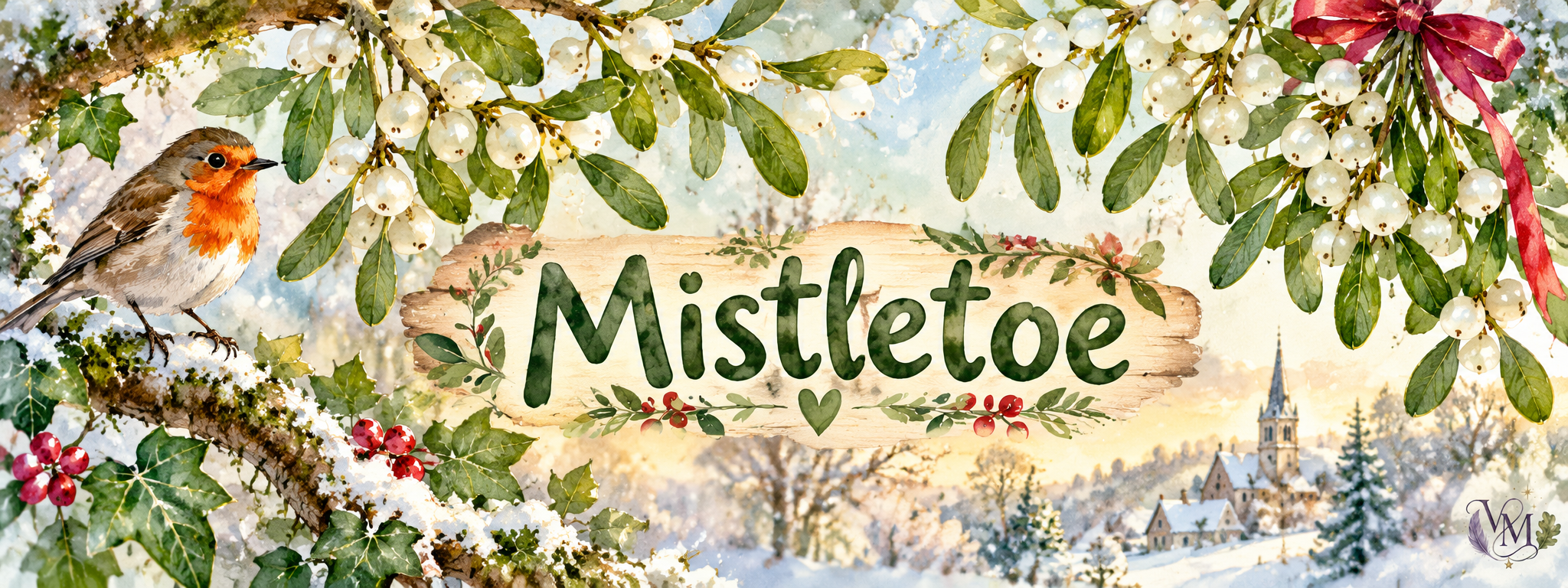
🌿 Mistletoe – Britain's Evergreen Winter Plant
Discovering Mistletoe in the UK
Mistletoe is one of Britain's most recognisable winter plants, known for its green leaves, pearly white berries and traditional connection with Christmas.
Unlike most familiar garden plants, mistletoe grows attached to the branches of living trees, forming rounded clusters of evergreen foliage high above the ground.
The species traditionally associated with Christmas in Britain is European mistletoe (Viscum album), a fascinating plant with unusual adaptations, important wildlife relationships and a long cultural history.
Although mistletoe is often noticed during December and the festive season, it remains green throughout the year, continuing to grow and develop on its host tree.
During winter, when many deciduous trees have lost their leaves, mistletoe becomes particularly easy to spot as green, rounded shapes among bare branches.
Mistletoe is especially interesting because it is both a flowering plant and a hemiparasite, producing much of its own food through photosynthesis while obtaining water and minerals from another plant.
🌱 What Does Mistletoe Look Like?
European mistletoe is an evergreen plant with yellowish-green stems, thick leaves and distinctive white berries.
Its leaves are usually smooth, oval or elongated, growing in opposite pairs along branching stems.
The stems repeatedly divide into forked branches, gradually creating the rounded or ball-shaped clusters commonly seen in trees.
Mature mistletoe plants can form large, rounded clusters exceeding one metre across, with some established plants reaching approximately two metres in height or spread.
Their size depends on age, growing conditions, available resources and the health of the host tree.
Mistletoe berries are typically small, round and pearly white, becoming noticeable during autumn and winter.
The berries contain sticky pulp surrounding the seeds, which plays an important role in helping mistletoe spread between trees.
🌟 Did You Know?
Mistletoe is sometimes described as a plant growing on another plant, but it is not simply resting on the branches.
It develops a specialised structure called a haustorium, which grows into the host's tissues and allows mistletoe to obtain water and dissolved minerals.
This connection helps mistletoe survive while its green leaves continue producing sugars through photosynthesis.
🌳 Where Does Mistletoe Grow?
European mistletoe grows on a variety of deciduous trees, including apple, lime, poplar, hawthorn and other suitable species.
It is particularly associated with traditional orchards, gardens, parkland and other open, well-lit habitats, where suitable host trees receive plenty of sunlight.
Although mistletoe grows on trees, it is less characteristic of dense, shaded woodland, where light availability and growing conditions may be less suitable.
Traditional orchards provide particularly favourable habitats because mature fruit trees, open growing conditions and visiting birds can support mistletoe establishment and seed dispersal.
In Britain, mistletoe is especially common in parts of western and central England, including Herefordshire, Worcestershire and Gloucestershire.
However, it can also be found in other parts of England and Wales, with more scattered occurrences elsewhere in the UK.
Mistletoe does not grow equally well on every tree species, and its distribution depends on suitable hosts, environmental conditions and opportunities for seeds to spread.
It is often easiest to identify during late autumn and winter, when the host tree's bare branches make the evergreen mistletoe more visible.
🌟 Did You Know?
Mistletoe is not equally common throughout Britain.
Some regions have large populations growing in orchards, gardens and mature trees, while other areas have relatively few naturally established plants.
Its distribution depends partly on climate, suitable host trees, light availability and seed dispersal.
🌿 Is Mistletoe a Parasite?
Mistletoe is a hemiparasitic plant, meaning it obtains water and mineral nutrients from another plant while carrying out its own photosynthesis.
Unlike a fully parasitic plant that depends heavily on its host for organic nutrients, European mistletoe has green leaves containing chlorophyll, allowing it to produce sugars using sunlight.
The plant develops a specialised structure called a haustorium, which connects with the water-conducting tissues of its host tree.
Through this connection, mistletoe absorbs water and dissolved minerals, helping it grow and remain green throughout the year.
Although mistletoe takes resources from its host, a small amount does not necessarily cause serious harm to a healthy, established tree.
However, heavy infestations can place additional stress on trees, particularly when they are already weakened by drought, disease or other environmental pressures.
🌟 Did You Know?
Mistletoe is unusual because it can be both a parasite and a producer of its own food.
It uses sunlight to make sugars through photosynthesis, while depending on its host tree for water and mineral nutrients.
This makes it an interesting example of how plants can develop different survival strategies.
❄️ What Happens to Mistletoe During Winter?
Unlike many deciduous plants, mistletoe remains evergreen throughout winter, keeping its leaves and green stems even when temperatures fall.
During the colder months, its rounded clusters become more visible because many host trees have shed their leaves.
Female mistletoe plants may carry white berries during autumn and winter, providing a seasonal food source for certain birds.
These berries can remain on the plant into spring, making them particularly useful when other fruits and berries have become scarce.
Mistletoe continues to photosynthesise when environmental conditions allow, although its growth and physiological activity vary with temperature, light and water availability.
Its thick leaves help it retain water, while its position in tree branches provides access to sunlight above much of the surrounding vegetation.
Mistletoe does not need to drop its leaves or disappear underground to survive winter, making it an interesting contrast to deciduous woodland and garden plants.
🌟 Did You Know?
When you see a green ball of mistletoe in a bare winter tree, you are looking at a plant that has remained green while its host has lost its leaves.
This difference makes mistletoe one of the easiest plants to recognise in some winter landscapes.
🌼 Does Mistletoe Have Flowers?
Although mistletoe is most famous for its white berries, it also produces small, yellowish-green flowers.
European mistletoe produces small, yellowish-green flowers during late winter and spring, with flowering times varying according to location, temperature and seasonal conditions.
Its flowers are relatively small and inconspicuous, making them much less noticeable than the white berries and evergreen leaves.
European mistletoe is dioecious, meaning male and female flowers grow on separate plants.
Only female mistletoe plants produce berries, and successful berry production generally requires pollen from male plants.
Following pollination, female plants gradually develop white berries, which become visible later in the year and may remain on the plant into spring.
The flowers can provide resources for visiting insects, while the berries become an important food source for certain birds during autumn, winter and early spring.
🌟 Did You Know?
A mistletoe plant covered in white berries is a female plant, because male plants do not produce berries.
However, male plants still play an important role by producing pollen needed for reproduction.
🐦 How Does Mistletoe Spread?
Mistletoe has a fascinating relationship with birds, which help transport its sticky seeds between trees.
The berries contain seeds surrounded by a sticky substance called viscin, helping them attach to branches and bark.
Two birds particularly associated with mistletoe in Britain are the mistle thrush and blackcap, although other birds may also feed on the berries.
🐦 Mistle Thrushes
Mistle thrushes may swallow whole mistletoe berries, later depositing undigested seeds through their droppings.
They can also wipe sticky seeds from their beaks onto branches, providing another way for mistletoe to spread between suitable host trees.
Because the seeds remain sticky after passing through the digestive system, they may attach to suitable branches and bark.
Mistle thrushes can also defend fruiting trees and valuable food sources, making mistletoe an important part of their seasonal feeding behaviour.
🐦 Blackcaps
Blackcaps often remove the berry pulp and wipe sticky seeds from their beaks onto branches, where the seeds may attach and begin growing.
This behaviour can be a particularly effective way of placing mistletoe seeds directly onto potential host branches.
Some blackcaps spend the winter in Britain, meaning they may encounter mistletoe berries during the colder months.
🌱 What Happens to the Seeds?
Once a mistletoe seed becomes attached to a suitable living branch, it can begin to germinate and develop a connection with its host.
However, not every seed successfully establishes, because growth depends on host suitability, environmental conditions and successful attachment.
🌟 Did You Know?
Mistletoe seeds do not usually grow successfully when planted in ordinary garden soil.
They are adapted to establish on suitable living host branches, where they can eventually develop the specialised connection needed for growth.
🐛 Why Is Mistletoe Important for Wildlife?
Mistletoe provides food, shelter and habitat opportunities for a variety of birds, insects and other wildlife.
Its berries are eaten by certain birds, including mistle thrushes and blackcaps, which also help disperse the seeds.
Mistletoe foliage can provide sheltered spaces among tree branches, offering opportunities for resting and nesting wildlife.
Several insects are associated with mistletoe, including the mistletoe marble moth (Celypha woodiana), whose caterpillars feed on mistletoe leaves.
Other specialised insects may also use mistletoe as a food source or part of their life cycle, contributing to local biodiversity.
Because mistletoe interacts with host trees, birds and insects, it forms part of a wider network of ecological relationships within orchards, gardens, parkland and other suitable habitats.
🌟 Did You Know?
Mistletoe can support specialised wildlife species that depend on it for food or habitat.
This means mistletoe is more than a Christmas decoration; it can also be an important part of local biodiversity.
🎄 Why Is Mistletoe Associated with Christmas?
Mistletoe has a long history of association with winter celebrations, seasonal traditions and European folklore.
In Britain, it is particularly familiar as a Christmas decoration, traditionally hung indoors during the festive season.
The custom of kissing beneath mistletoe became especially popular in Britain during the 18th and 19th centuries, although its precise origins are not fully established.
Mistletoe also appears in older European stories and traditions, where it has been associated with fertility, protection, peace and good fortune.
Some historical accounts connect mistletoe with ancient Druids and Celtic traditions, although the surviving evidence is limited and later retellings have sometimes added details that cannot be verified.
Today, mistletoe remains a familiar symbol of Christmas, winter greenery and seasonal celebration, appearing in decorations, illustrations, cards and festive displays.
🌟 Did You Know?
The tradition of kissing beneath mistletoe is a cultural custom, not a rule.
People should always be able to choose whether they want physical contact, and personal boundaries and consent remain important during celebrations.
Children can explore the tradition through stories, illustrations and historical discussions without any expectation of participating in physical contact.
🌳 Does Mistletoe Really Grow on Oak Trees?
Although mistletoe is often associated with oak trees in ancient stories and traditions, it is actually rarely found growing on native British oaks.
In Britain, European mistletoe is much more commonly found on apple, lime, poplar and hawthorn trees.
Its association with oak trees is particularly interesting because historical accounts describe mistletoe growing on oaks as significant, even though such occurrences are uncommon.
This creates an opportunity to compare cultural traditions and scientific observations, helping children understand that folklore and botanical evidence provide different kinds of information.
🌟 Did You Know?
Although mistletoe growing on an oak tree is often mentioned in ancient folklore, it is unusual in the British countryside.
You are much more likely to spot mistletoe growing in an apple orchard or on a suitable parkland tree than on a native British oak.
⚠️ Is Mistletoe Safe to Touch or Eat?
All parts of European mistletoe, including its leaves, stems and berries, contain potentially harmful substances and should never be eaten or tasted.
The leaves and stems can be more toxic than the berries, so it is important not to assume that only the white berries present a risk.
Although some wild birds can eat mistletoe berries, this does not mean they are safe for humans or household pets.
Children should be encouraged to observe mistletoe without putting any part of the plant in their mouths.
When using real mistletoe as a decoration, adults should keep it away from young children and pets, remove fallen berries and avoid using real plant material in children's sensory or food activities.
For educational activities, photographs, illustrations, artificial decorations and printed resources provide safer alternatives to handling real mistletoe.
Adults handling real mistletoe may also choose to wear gardening gloves and wash their hands afterwards, particularly when preparing cut decorations.
🚨 What Should You Do If Someone Eats Mistletoe?
If someone swallows mistletoe, remove any remaining plant material from their mouth, do not deliberately make them vomit, and seek prompt medical advice rather than waiting for symptoms.
In the UK, NHS 111 can provide advice for non-emergency concerns in England, while equivalent urgent-care services are available in Scotland, Wales and Northern Ireland.
If someone develops severe symptoms, breathing difficulties, seizures or becomes unconscious, call 999 immediately.
If a pet eats mistletoe, contact a veterinary professional promptly for advice.
🌟 Did You Know?
Mistletoe berries may be eaten by certain wild birds, but that does not mean they are safe for humans or household pets.
Different animals have different digestive systems and tolerances, so foods that are suitable for wildlife may be harmful to people or other animals.
🌳 Can Mistletoe Harm Trees?
Mistletoe depends on living host trees for water and mineral nutrients, creating a close relationship between the two plants.
A small number of mistletoe plants may have limited effects on a healthy mature tree, particularly when water and nutrients are readily available.
However, heavy mistletoe growth can increase water demand and competition for resources, potentially weakening stressed or vulnerable trees.
In orchards, mistletoe may sometimes require careful management, particularly where fruit trees are heavily affected.
At the same time, mistletoe supports birds, insects and wider biodiversity, so removing every plant is not necessarily beneficial for wildlife conservation.
Responsible management involves considering tree health, local wildlife and the extent of mistletoe growth, rather than assuming that all mistletoe is harmful.
🌍 Is Mistletoe Native to the UK?
European mistletoe (Viscum album) is considered native to Great Britain, occurring naturally in suitable habitats and geographical regions.
Although it is native to Britain, mistletoe is generally regarded as introduced rather than native to Ireland, where it remains relatively uncommon.
It is particularly associated with southern, western and central parts of England, where traditional orchards and suitable host trees provide favourable conditions.
Mistletoe is less common in many northern and upland areas, although local populations and planted specimens may occur outside its main distribution.
Its natural distribution reflects a combination of climate, host availability, light conditions and seed dispersal, showing how different environmental factors influence plant populations.
Because mistletoe is part of Britain's native flora, it can contribute to local biodiversity and wildlife relationships.
🌿 Is Mistletoe an Endangered Plant?
European mistletoe is native to Britain and is currently classified as Least Concern on the IUCN Red List, meaning it is not considered globally threatened with extinction.
However, its populations are unevenly distributed across Britain, and its presence depends on suitable host trees, local environmental conditions and opportunities for seed dispersal.
It is relatively common in parts of western and central England, but much less frequent in some northern and upland regions.
This means a plant can be secure at a global level while still being uncommon or locally significant in particular geographical areas.
Protecting traditional orchards, suitable host trees and associated wildlife habitats remains important for local biodiversity and specialist species.
Some insects depend closely on mistletoe as a food source or habitat, meaning changes in mistletoe availability and habitat management may affect their populations.
Conservation involves maintaining healthy habitats and balanced ecological relationships, rather than assuming that every mistletoe plant must be preserved or removed.
🌟 Did You Know?
A plant can be widespread and not globally threatened, while still providing important resources for particular wildlife species.
This is why conservation is about more than protecting rare plants and animals; it also involves maintaining the relationships that support healthy ecosystems.
🔍 Mistletoe Facts to Remember
🌿 Scientific name: Viscum album.
🌍 Native status: Native to Great Britain; generally considered introduced to Ireland.
🎨 Appearance: Yellowish-green stems, evergreen leaves and pearly white berries.
🌳 Plant type: Evergreen hemiparasitic flowering plant.
☀️ Photosynthesis: Produces sugars using sunlight while obtaining water and minerals from its host.
🏡 Preferred habitats: Traditional orchards, gardens, parkland and other open, well-lit places.
🌳 Host trees: Often found on apple, lime, poplar and other suitable trees.
🌳 Oak trees: Mistletoe is uncommon on native British oaks despite its association with ancient folklore.
📏 Size: Mature plants can exceed one metre across, with some reaching approximately two metres.
❄️ Winter appearance: Remains green and becomes easier to spot among bare branches.
🌼 Flowers: Small, yellowish-green flowers appearing during late winter and spring.
⚪ Berries: Produced by female plants following successful pollination; may remain into spring.
🐦 Seed dispersal: Mistle thrushes, blackcaps and other birds help transport sticky seeds between trees.
🐛 Wildlife importance: Provides food and habitat for certain birds and insects.
🎄 Cultural connection: Associated with Christmas decorations and kissing traditions.
⚠️ Safety: All parts are potentially harmful if swallowed; keep real mistletoe away from young children and pets.
🌱 Conservation status: Least Concern globally, while remaining important for local biodiversity.
💚 Exploring Mistletoe Through Inclusive Learning
Learning about mistletoe offers opportunities for winter nature discovery, plant investigations and sensory-friendly activities suitable for children with different interests, abilities and learning needs.
Children can explore the topic through photographs, illustrations, creative projects, storytelling and visual investigations, without needing to touch, taste or handle real mistletoe.
Some children may enjoy comparing evergreen and deciduous plants, while others prefer drawing, sorting pictures, exploring safe textures or investigating plant life cycles.
Activities can be adapted to support different communication styles, sensory preferences, physical abilities and developmental stages, ensuring children can participate in ways that feel comfortable and meaningful.
Children may also explore how mistletoe grows on trees, how birds spread seeds and why some plants remain green during winter, using models, pictures, storytelling or practical demonstrations.
🌿 Exploring Plant Relationships
Children can investigate the relationship between mistletoe and its host tree using simple diagrams, matching activities or model-building resources.
This can introduce the concept of hemiparasitism in an accessible way, helping children understand that some plants depend on other living plants for particular resources.
🐦 Exploring Seed Dispersal
Children can discover how mistle thrushes and blackcaps help spread seeds, using illustrated sequences, storytelling or safe craft demonstrations.
These activities can encourage understanding of plant reproduction, animal behaviour and ecological relationships without requiring real berries or seeds.
❄️ Exploring Winter Plants
Children can compare evergreen mistletoe with deciduous trees, investigating which plants retain their leaves and which lose them during winter.
This can be explored through photographs, outdoor observation, sensory-friendly craft activities or visual sorting games, depending on individual preferences and abilities.
🎄 Exploring Seasonal Traditions
Children can learn about mistletoe's connection with Christmas and British folklore, comparing historical stories with modern scientific knowledge.
Activities should respect different family traditions, beliefs and cultural backgrounds, ensuring children can participate without pressure or expectations around physical contact.
🌱 Different Ways to Participate
For sensory exploration, adults can use artificial leaves, soft craft materials, printed images and other safe alternatives, avoiding real berries or potentially harmful plant parts.
Children who prefer visual learning, quiet observation, movement-based activities, assisted communication or hands-on exploration should have equally meaningful opportunities to participate.
The aim is to encourage curiosity, understanding and respect for nature, while helping children develop an appreciation of Britain's winter plants and wildlife.
🌿 Explore Our Mistletoe Resources
Discover a growing collection of free educational activities, creative resources and inclusive learning opportunities inspired by European mistletoe and its place in British nature.
From evergreen plant investigations and seed dispersal activities to winter wildlife connections, seasonal traditions and creative exploration, our resources encourage children to observe, discover and learn at their own pace.
Every child deserves the opportunity to explore nature in a way that works for them.