
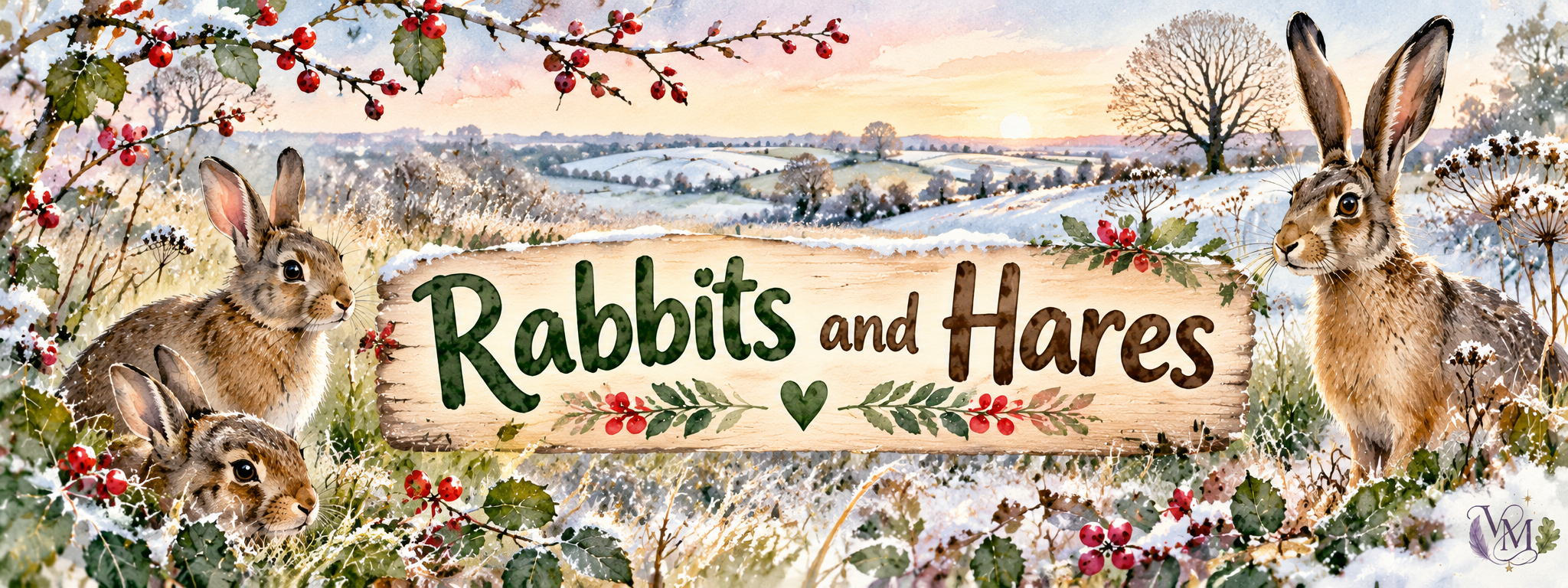
🐇 Rabbits and Hares – Britain's Long-Eared Mammals
Discovering Rabbits and Hares in the UK
Rabbits and hares are among Britain's most recognisable countryside mammals, known for their long ears, powerful back legs and remarkable ability to move quickly.
Although they may look similar, rabbits and hares are different animals, with distinct behaviours, habitats and ways of raising their young.
In the UK, the most familiar species are the European rabbit (Oryctolagus cuniculus), the brown hare (Lepus europaeus) and the mountain hare (Lepus timidus), which includes the Irish hare found in Northern Ireland.
These mammals belong to a group called lagomorphs, which also includes pikas found in other parts of the world.
Unlike rodents, lagomorphs have two pairs of upper incisor teeth, helping scientists distinguish them from mice, rats, squirrels and other rodents.
During winter, rabbits and hares use different strategies to find food, avoid predators and survive colder conditions, making them fascinating animals to explore during the December Nature Hub.
🌍 Are Rabbits and Hares Native to Britain?
Although European rabbits, brown hares and mountain hares all live in Britain today, they have different histories and geographical origins.
The mountain hare is Britain's only native lagomorph, having lived in parts of Britain since prehistoric times.
The brown hare was introduced to Britain many centuries ago, possibly during the Iron Age or Roman period, although its precise arrival date remains uncertain.
The European rabbit was also introduced by humans, becoming established during the medieval period, traditionally associated with the Norman era.
Over time, both rabbits and brown hares became established parts of Britain's countryside, occupying a variety of grassland, farmland and other suitable habitats.
Understanding the difference between native and introduced species helps us explore how wildlife populations change, spread and adapt over time.
🌟 Did You Know?
The mountain hare is native to Britain, while the European rabbit and brown hare were introduced by humans.
However, all three species have become familiar parts of Britain's wildlife and countryside landscapes, even though their histories are different.
🌿 What Is the Difference Between a Rabbit and a Hare?
Although rabbits and hares share some similar physical features, there are several important differences in their appearance, behaviour and lifestyles.
🐰 European Rabbits
European rabbits usually have smaller, rounder bodies, relatively short ears and powerful hind legs.
Their fur is generally greyish-brown, although colour can vary, and they have a short, fluffy tail with a pale underside.
Rabbits are highly social animals that often live in groups or colonies, sharing underground tunnel systems known as warrens.
When threatened, rabbits usually try to escape into underground burrows, using their speed, alertness and familiar escape routes to avoid danger.
🐇 Brown Hares
Brown hares are generally larger and more slender than rabbits, with longer legs and longer ears.
Their ears often have distinctive black tips, while their coats are usually warm brown or golden-brown with lighter undersides.
Unlike rabbits, brown hares usually spend much of their time above ground, resting in shallow depressions called forms.
When threatened, hares rely on their exceptional running speed, powerful legs and ability to change direction quickly.
❄️ Mountain Hares
Mountain hares are adapted to colder, more exposed environments, particularly the upland and mountainous habitats of Scotland.
They have compact bodies, relatively short ears and thick fur, helping reduce heat loss in cold conditions.
Many mountain hares develop a white winter coat, providing camouflage against snow-covered landscapes.
However, the extent of this colour change varies, and not every mountain hare becomes completely white.
🍀 What About the Irish Hare?
The Irish hare (Lepus timidus hibernicus) is a distinctive subspecies of the mountain hare, found across the island of Ireland, including Northern Ireland.
Although closely related to Scottish mountain hares, Irish hares have developed some different characteristics, reflecting their habitats and environmental conditions.
Unlike many mountain hares in Scotland, Irish hares usually retain their brownish coats during winter, rather than becoming completely white.
Irish hares can be found in grasslands, farmland, coastal areas and upland habitats, using vegetation and natural ground cover for shelter.
They are an important part of Ireland's native wildlife, contributing to grazing patterns and local food webs.
🌟 Did You Know?
The Scottish mountain hare and Irish hare belong to the same species, but their winter coats can look very different.
This demonstrates how animals can develop different characteristics within the same species, depending on geographical location and environmental conditions.
📏 How Big Are Rabbits and Hares?
European rabbits are generally smaller and lighter than hares, although size varies between individuals.
An adult European rabbit typically measures approximately 35–45 centimetres long and commonly weighs around 1.2–2 kilograms.
A brown hare usually measures approximately 50–70 centimetres long and commonly weighs around 2–5 kilograms.
A mountain hare generally measures approximately 45–56 centimetres long, with a weight of around 2.5–3.5 kilograms.
These measurements are typical approximate ranges rather than absolute limits, because size can vary with age, sex, habitat and individual development.
🏡 Where Do Rabbits and Hares Live?
Rabbits and hares can be found in a variety of UK countryside habitats, although they have different preferences for shelter, feeding and resting.
🐰 Rabbit Warrens
European rabbits often live in grasslands, farmland, woodland edges, coastal dunes and other areas where they can find suitable soil for digging.
They create underground homes called warrens, consisting of burrows, entrances and connecting tunnels.
These underground spaces provide shelter from predators and bad weather, as well as protected areas for resting and raising young.
Rabbit colonies may use several entrances and escape routes, allowing individuals to retreat underground quickly when threatened.
🐇 Hare Forms
Brown hares do not usually create underground warrens.
Instead, they rest in shallow depressions in the ground, known as forms, which may be hidden among long grass, crops or other vegetation.
These resting places provide some shelter and camouflage, allowing hares to remain still and difficult to spot.
Brown hares are particularly associated with open farmland, grassland and mixed agricultural landscapes, where they can feed and move across large areas.
❄️ Mountain Hare Habitats
In Britain, mountain hares are most strongly associated with Scottish uplands, moorlands and mountainous landscapes.
They may shelter among heather, rocks, vegetation and natural hollows, using the landscape to reduce exposure to wind and predators.
Mountain hares are naturally native to parts of Scotland, while populations in some other British areas have resulted from historical introductions.
❄️ What Do Rabbits and Hares Do During Winter?
Unlike some mammals, rabbits and hares do not hibernate during winter.
Instead, they remain active throughout the colder months, continuing to search for food, avoid predators and find shelter.
However, their winter survival strategies differ depending on species, habitat and environmental conditions.
🐰 Rabbits in Winter
European rabbits continue to feed throughout winter, although they may spend more time sheltering underground during particularly harsh weather.
Their warrens provide protection from cold winds, heavy rain and some temperature extremes, helping them conserve energy and remain sheltered.
Rabbits may feed on grass, shoots, roots, bark and other available vegetation when their usual food sources become less abundant.
🐇 Brown Hares in Winter
Brown hares remain active during winter, using their thick fur, sheltered resting places and powerful running abilities to survive.
They may rest in forms protected by vegetation or uneven ground, reducing their exposure to wind and harsh weather.
Because they do not normally shelter in underground burrows, brown hares depend heavily on camouflage, alertness and rapid escape.
Their brown coats generally remain brown throughout winter, helping them blend into fields, soil and dried vegetation.
❄️ Mountain Hares in Winter
Mountain hares have some of the most distinctive winter adaptations among Britain's wild mammals.
Their coats become thicker during colder months, helping provide insulation against low temperatures.
Many mountain hares change from brownish-grey summer fur to white winter fur, improving their camouflage in snowy environments.
They may also shelter in natural hollows or behind vegetation, reducing exposure to cold winds and severe weather.
🎨 Why Do Mountain Hares Turn White?
Many mountain hares change their coats through a process called seasonal moulting, during which older fur is replaced by a different seasonal coat.
This change is influenced strongly by changing daylight hours, with temperature and other environmental conditions also affecting the process.
During winter, a white coat can help mountain hares blend into snowy surroundings, making them less visible to predators.
However, when snowfall is limited or snow melts earlier than expected, a white hare may become more noticeable against dark vegetation.
Scientists call this problem camouflage mismatch, because the animal's coat colour no longer matches its surroundings.
Changes in winter temperatures, snowfall patterns and seasonal conditions may increase the risk of camouflage mismatch in some mountain hare populations.
🌟 Did You Know?
A mountain hare may develop its white winter coat before snow arrives, or remain white after snow has melted.
This happens because seasonal coat changes are strongly influenced by daylight, rather than being triggered only by the presence of snow.
🌱 What Do Rabbits and Hares Eat?
Rabbits and hares are herbivores, meaning they eat plant-based foods.
Their diets include grasses, herbs, shoots, leaves and other vegetation, although the exact foods available depend on season and habitat.
European rabbits frequently graze on short grasses and other low-growing plants, sometimes feeding in groups near their warrens.
Brown hares often feed on grasses, agricultural crops and wild plants, moving across open habitats to find suitable food.
Mountain hares may eat heather, grasses, sedges and other upland vegetation, particularly where winter weather limits access to fresh growth.
During colder months, rabbits and hares may also feed on woody plant material, including twigs, bark and shoots when other vegetation is scarce.
🌟 Did You Know?
Rabbits and hares have a special digestive adaptation called caecotrophy, which helps them obtain additional nutrients from their food.
They produce special soft droppings called caecotrophs, which they usually eat directly from the body.
These are digested again, allowing the animals to absorb nutrients produced during fermentation in the digestive system.
Although this behaviour may seem unusual, it is a normal and important part of rabbit and hare digestion.
👨👩👧👦 Do Rabbits and Hares Live in Families?
Rabbits and hares have different social behaviours, particularly when it comes to living arrangements and raising their young.
🐰 Rabbit Colonies
European rabbits are generally social mammals, often living in groups or colonies.
They communicate through body language, scent-marking and sounds, helping them recognise other rabbits and potential dangers.
Rabbits may also thump their hind feet against the ground, producing vibrations and sounds that can warn nearby rabbits of danger.
🐇 Hare Behaviour
Brown hares are generally more solitary than rabbits, although they may gather in feeding areas or during the breeding season.
During spring, brown hares are sometimes seen chasing and boxing, behaviours associated with courtship and mating interactions.
Although these encounters are often described as fights between males, boxing frequently involves females resisting unwanted attention from males.
Mountain hares are also generally less socially organised than rabbits, although they may sometimes gather in groups where food or suitable habitat is available.
🐾 What Are Baby Rabbits and Hares Called?
Baby rabbits and hares have different names and different early development, reflecting their different ways of living.
🐰 Baby Rabbits – Kits or Kittens
Baby rabbits are called kits or kittens.
They are usually born underground in sheltered nests, where their mother has prepared soft bedding using vegetation and fur.
Newborn rabbit kits are blind, largely hairless and unable to survive independently, relying on their mother for milk, warmth and protection.
As they develop, they gradually grow fur, open their eyes and begin exploring, eventually leaving the nest as they become more independent.
🐇 Baby Hares – Leverets
Baby hares are called leverets.
Unlike rabbit kits, leverets are born with fur, open eyes and the ability to move, helping them survive in above-ground resting places.
Their mothers usually leave them hidden and resting quietly for long periods, returning to feed them with milk.
This behaviour helps reduce the risk of attracting predators to their hiding places.
🌟 Did You Know?
A young hare sitting alone in a field is not necessarily abandoned, because its mother normally leaves it hidden between feeding visits.
If you discover a healthy leveret, do not pick it up, feed it or move it. Instead, keep children and pets away and allow its mother to return.
If the leveret is visibly injured, has been caught by a cat or dog, or appears seriously unwell, contact a qualified wildlife rescue organisation or veterinary professional for guidance.
🌳 Why Are Rabbits and Hares Important?
Rabbits and hares play important roles in British grasslands, farmland and wider ecosystems, contributing to food webs, vegetation management and habitat processes.
By grazing on grasses and other plants, they can influence vegetation height, plant growth and the structure of habitats.
Rabbit burrowing activities can move and loosen soil, creating small habitat features that may benefit other organisms.
Rabbits and hares also provide food for predators such as foxes, birds of prey and other carnivores, making them important components of natural food webs.
Their presence can influence the balance of plant and animal communities, although high rabbit populations may also cause damage to crops and sensitive habitats.
Protecting connected grasslands, hedgerows, field margins and suitable upland habitats helps support healthy populations of rabbits, hares and other wildlife.
⚖️ Are Rabbits and Hares Protected in the UK?
Rabbits and hares are subject to different wildlife protection and management laws across the United Kingdom.
European rabbits may be managed lawfully in certain circumstances, particularly where they cause agricultural or environmental damage.
Brown hares receive legal protections, although the rules and permitted activities vary between UK nations.
In Scotland, brown hares have a closed season from 1 February to 30 September, during which killing or taking them is generally prohibited unless specifically authorised by law.
Mountain hares in Scotland receive year-round protection under the Wildlife and Countryside Act 1981, as amended, with certain activities permitted only under specific licences or legal exceptions.
In Northern Ireland, Irish hares are subject to separate wildlife legislation and conservation measures, and the applicable rules may differ from those in Great Britain.
Because wildlife legislation can be complex and subject to change, anyone considering land management, wildlife control or activities affecting these species should consult current official guidance for the relevant UK nation.
For children and families, the most important message is to observe wild rabbits and hares respectfully, avoid disturbing burrows, nests or resting places, and give animals space to behave naturally.
❄️ How Do Rabbits and Hares Survive Freezing Weather?
Although rabbits and hares remain active throughout winter, their survival depends on suitable shelter, food availability and physical adaptations.
European rabbits can retreat into underground warrens, where they gain protection from cold winds and harsh weather.
Brown hares rely on camouflage, sheltered forms and rapid movement, helping them avoid predators and reduce exposure.
Mountain hares have thick winter coats and seasonal colour changes, supporting survival in cold upland environments.
Irish hares generally retain brownish winter coats, demonstrating that even closely related animals can have different seasonal adaptations.
These different strategies show that animals do not all survive winter in the same way, even when they are closely related.
🔍 Rabbit and Hare Facts to Remember
🐰 European rabbit: Oryctolagus cuniculus.
🐇 Brown hare: Lepus europaeus.
❄️ Mountain hare: Lepus timidus.
🍀 Irish hare: Lepus timidus hibernicus, a subspecies of the mountain hare.
🌍 Origins: Mountain hares are native to Britain; European rabbits and brown hares were introduced.
🏡 Rabbit homes: Underground burrows and warrens.
🌿 Hare resting places: Shallow above-ground depressions called forms.
🌱 Diet: Grasses, leaves, shoots and other plant material.
❄️ Winter behaviour: Rabbits and hares remain active and do not hibernate.
🎨 Winter camouflage: Many Scottish mountain hares develop white winter coats.
🍀 Irish hare adaptation: Usually retains a brownish coat during winter.
👨👩👧👦 Social behaviour: Rabbits are generally more social than hares.
🐾 Baby rabbits: Kits or kittens.
🐾 Baby hares: Leverets.
🌳 Ecological importance: Grazing, soil disturbance and supporting natural food webs.
💚 Exploring Rabbits and Hares Through Inclusive Learning
Learning about rabbits and hares offers opportunities for wildlife discovery, seasonal exploration and sensory-friendly activities suitable for children with different interests, abilities and learning needs.
Children can explore the topic through photographs, illustrations, storytelling, creative activities and habitat investigations, without needing to encounter wild animals or enter their habitats.
Some children may enjoy comparing rabbit and hare footprints, while others prefer drawing, sorting pictures, exploring textures or investigating different habitats.
Activities can be adapted to support different communication styles, sensory preferences, physical abilities and developmental stages, ensuring children can participate in ways that feel comfortable and meaningful.
Children may also enjoy exploring how animals move, where they shelter and how their bodies help them survive, using movement, imaginative play, visual resources or practical investigations.
The aim is to encourage curiosity, understanding and respect for wildlife, while helping children develop an appreciation of Britain's natural habitats.
🌿 Explore Our Rabbit and Hare Resources
Discover a growing collection of free educational activities, creative resources and inclusive learning opportunities inspired by rabbits, brown hares, mountain hares and Irish hares found across the UK.
From animal identification and habitat comparisons to winter survival, seasonal camouflage and creative exploration, our resources encourage children to observe, discover and learn at their own pace.
Every child deserves the opportunity to explore nature in a way that works for them.