
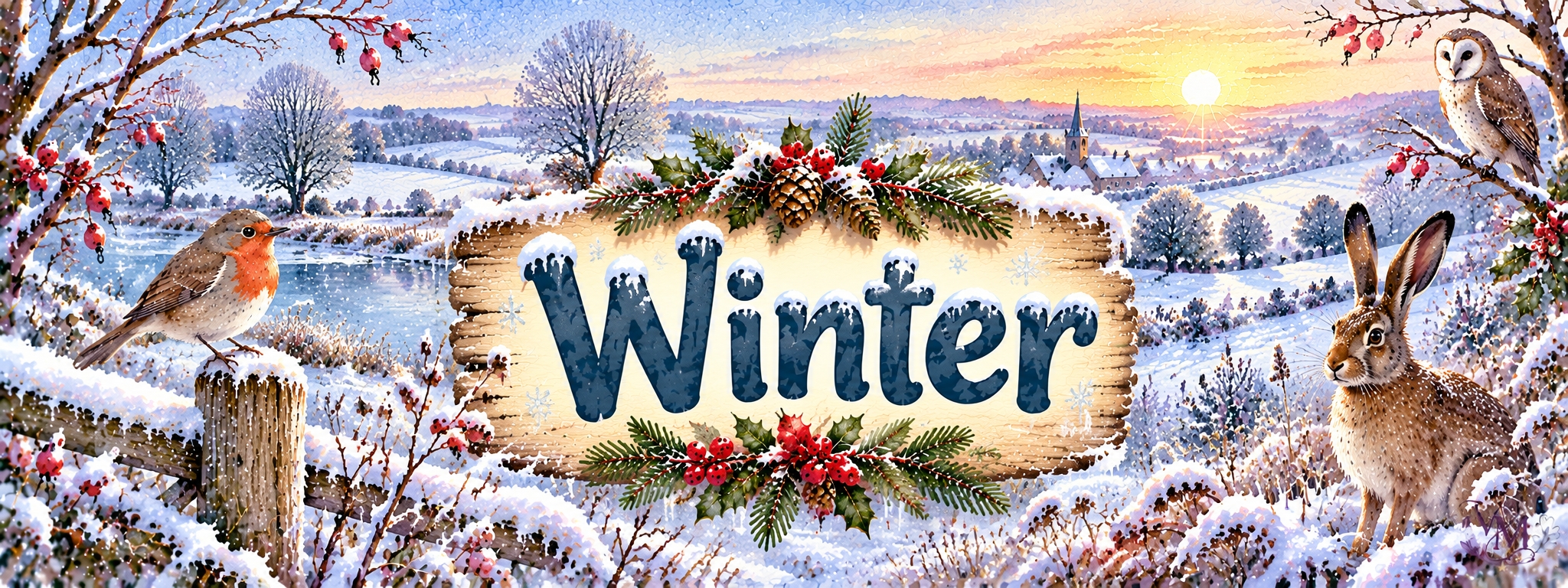
❄️ Winter in the UK – Discovering the Coldest Season
Discovering Winter in Britain
Winter is one of the four seasons of the year, bringing shorter days, longer nights and generally colder weather to the United Kingdom.
During winter, the British countryside can look very different from the landscapes we see in spring, summer and autumn.
Many deciduous trees have lost their leaves, some animals become less active or change their behaviour, and the countryside may experience frost, ice, snow, rain or strong winds.
However, winter is not simply a time when nature stops growing or wildlife disappears.
Beneath fallen leaves, inside trees, underground and within ponds, plants and animals continue surviving, adapting and responding to seasonal changes.
Some birds migrate to warmer regions, while others travel to Britain from colder northern areas.
Certain mammals enter periods of hibernation or reduced activity, while others remain active throughout the winter months.
Winter is also a season of important natural processes, helping shape plant growth, animal life cycles, habitats and seasonal ecosystems.
🌍 Why Does Winter Happen?
Winter happens because Earth travels around the Sun while tilted on its axis.
Earth's axis is tilted by approximately 23.4 degrees, meaning different parts of the planet receive different amounts of sunlight throughout the year.
During winter in the Northern Hemisphere, which includes the United Kingdom, Earth's northern half is tilted away from the Sun.
This causes the Sun to appear lower in the sky, while daylight hours are shorter than during the summer months.
Around the December solstice, the Northern Hemisphere reaches its greatest tilt away from the Sun.
After the solstice, daylight gradually increases, even though winter continues for several more months.
Because sunlight reaches the ground at a lower angle and for fewer hours, the Northern Hemisphere generally receives less solar energy during winter.
This reduction in solar energy contributes to colder seasonal temperatures, although local weather and geographical conditions also influence how cold winter becomes.
🌟 Did You Know?
Winter does not happen because Earth moves much farther away from the Sun.
In fact, Earth is usually closest to the Sun in early January, during winter in the Northern Hemisphere.
This point in Earth's orbit is called perihelion.
The seasons are mainly caused by Earth's axial tilt, which changes day length and the angle of sunlight.
🌏 Is It Winter Everywhere in December?
Although Britain experiences winter during December, not every country experiences the same season at the same time.
The Northern and Southern Hemispheres have opposite astronomical seasons because Earth's axis remains tilted in approximately the same direction as the planet travels around the Sun.
When the Northern Hemisphere is tilted away from the Sun, the Southern Hemisphere is tilted towards it.
This means countries such as Australia and New Zealand experience summer during December, while Britain and much of Europe experience winter.
During June, the situation is reversed.
Britain experiences summer, while much of the Southern Hemisphere experiences winter.
However, seasonal conditions are not identical everywhere, and tropical regions may experience wet and dry seasons rather than four strongly contrasting temperature-based seasons.
🌟 Did You Know?
Christmas takes place during winter in Britain, but during summer in Australia and New Zealand.
This means Christmas celebrations in different countries may take place during very different weather conditions, including cold winter days or warm summer sunshine.
📅 When Does Winter Begin and End in the UK?
There are two commonly used ways of defining winter: meteorological winter and astronomical winter.
🌨️ Meteorological Winter
Meteorological winter follows the calendar months, making it useful for weather records, climate comparisons and seasonal statistics.
In the UK, meteorological winter includes:
December
January
February
This means meteorological winter begins on 1 December and ends on the final day of February.
🌌 Astronomical Winter
Astronomical winter is based on Earth's position in its orbit around the Sun.
It begins at the December solstice, usually occurring on 21 or 22 December, although the exact date and time can vary.
Astronomical winter ends at the March equinox, usually occurring around 20 March.
🌟 Did You Know?
Both definitions of winter are scientifically valid, but they are used for different purposes.
Meteorologists often use December, January and February because these fixed months make weather and climate records easier to compare.
Astronomers use the solstices and equinoxes, which are connected to Earth's movement around the Sun.
🌅 Why Are Winter Days Shorter?
During winter, the Northern Hemisphere is tilted away from the Sun, causing shorter daylight hours and longer nights.
In Britain, this change becomes particularly noticeable during November and December, when sunrise becomes later and sunset occurs earlier.
The amount of daylight also varies depending on where you live in the UK.
Northern locations, such as Scotland, generally experience shorter winter days than southern locations, such as southern England.
This happens because day length changes with latitude, especially during the winter and summer seasons.
Around the December solstice, southern England receives approximately eight hours of daylight, while northern Scotland receives considerably less.
After the solstice, the total amount of daylight gradually increases, even though winter temperatures may remain cold for several more months.
🌟 Did You Know?
The shortest day of the year does not necessarily have the latest sunrise or earliest sunset.
In Britain, the earliest sunset usually occurs before the December solstice, while the latest sunrise usually occurs afterwards.
This happens because of the relationship between Earth's axial tilt, its movement around the Sun and the difference between apparent solar time and clock time.
As a result, some people notice evenings beginning to get slightly lighter before Christmas, even though the shortest day has not yet arrived.
🌌 What Is the Winter Solstice?
The winter solstice is the moment when the Northern Hemisphere is tilted most strongly away from the Sun.
It marks the shortest day and longest night of the year in terms of daylight duration.
In the UK, the December solstice usually occurs on 21 or 22 December.
After the solstice, the total amount of daylight begins increasing, although sunrise and sunset times do not change at exactly the same rate.
This means the latest sunrise can occur after the solstice, even though the total daylight period has already begun increasing.
The winter solstice has also been recognised by many cultures throughout history, often becoming associated with seasonal celebrations, gatherings and the return of longer days.
🌟 Did You Know?
The winter solstice is not necessarily the coldest day of the year.
The land, sea and atmosphere take time to respond to changes in solar energy, meaning the coldest weather often occurs later in winter.
This delay is sometimes called seasonal lag.
🌡️ What Is Winter Weather Like in the UK?
British winter weather is highly variable, with conditions changing according to location, altitude, prevailing winds and weather systems.
Some winter days are cold, dry and sunny, while others bring rain, cloud, strong winds or prolonged damp conditions.
Snow and frost are more likely during cold weather, but they do not occur everywhere or every winter.
🌧️ Rain
Rain is a common feature of British winters, particularly when moist air and Atlantic weather systems move across the country.
Some western and upland areas experience particularly high rainfall, although conditions vary considerably between regions.
🌬️ Wind
Winter storms can bring strong winds and heavy rain, sometimes causing fallen branches, flooding or travel disruption.
Coastal and exposed upland locations may experience particularly strong winds.
❄️ Snow
Snow can fall when atmospheric conditions allow ice crystals to form and reach the ground without completely melting.
Snowfall is more frequent in some northern and upland areas, although southern and lowland locations can also experience snow.
🧊 Ice
Ice forms when water freezes, creating slippery surfaces and frozen puddles.
Roads, pavements and shaded areas can become dangerously icy, even when snow is not present.
🌟 Did You Know?
Winter weather in Britain can be very different from one place to another.
A mountain in Scotland might experience heavy snowfall, while a coastal town in southern England has rain and relatively mild temperatures.
This is partly because altitude, distance from the sea and local weather systems influence temperature and precipitation.
❄️ What Is Frost?
Frost is associated with freezing temperatures and ice forming on cold surfaces.
One familiar type is hoar frost, which develops when water vapour changes directly into ice crystals on a sufficiently cold surface.
This process is called deposition.
However, some white frost can also form when dew or tiny liquid water droplets freeze, meaning not all frost develops in exactly the same way.
Frost is particularly likely during clear, calm nights, when grass, leaves, cars and other exposed surfaces lose heat.
Because these surfaces can become colder than the surrounding air, frost may develop even when forecast air temperatures remain slightly above 0°C.
🌟 Did You Know?
A weather forecast might report an air temperature of 2°C, while grass and car windscreens still become frosty.
This happens because surface temperatures can fall below freezing, even when the air temperature measured above the ground remains slightly warmer.
🌨️ How Does Snow Form?
Snow begins high in the atmosphere, where water vapour can form ice crystals inside clouds.
These ice crystals grow as water vapour deposits onto them and may combine with other ice crystals to form snowflakes.
When the crystals become heavy enough, they fall towards the ground.
If the air below the cloud remains cold enough, the snowflakes may reach the ground without melting completely.
However, snow can sometimes reach the ground when air temperatures are slightly above 0°C, depending on humidity, precipitation intensity and atmospheric conditions.
❄️ Are All Snowflakes Different?
Snowflakes can develop many different shapes and patterns, influenced by temperature and moisture conditions inside clouds.
Many snow crystals display six-sided symmetry, reflecting the molecular structure of ice.
Although snowflakes can look remarkably different, scientists cannot claim that every snowflake that has ever formed is completely unique.
🌟 Did You Know?
Snowflakes are not always shaped like perfect six-pointed stars.
They can form plates, columns, needles and more complex branching structures, depending on conditions inside the cloud.
🌱 Can Snow Help Protect Plants?
Although snow is cold, a layer of snow can sometimes protect soil, roots and low-growing plants from even colder air temperatures.
Fresh snow contains many tiny air spaces, which can help reduce the transfer of heat.
When a sufficiently deep layer settles over the ground, it can act as a form of insulation, slowing heat loss from the soil beneath.
This means plants covered by snow may sometimes experience more stable temperatures than plants exposed directly to very cold air and strong winds.
However, snow does not always benefit plants.
Heavy, wet snow can bend or break branches, while prolonged snow cover may affect light availability and growing conditions.
The effects depend on snow depth, temperature, plant species and local environmental conditions.
🌟 Did You Know?
A blanket of snow can sometimes help protect plants from severe cold, even though the snow itself is frozen water.
This happens because the air trapped within the snow reduces heat transfer, helping insulate the ground underneath.
🧊 Why Does Water Freeze?
Pure water normally freezes at approximately 0°C under standard atmospheric pressure, although dissolved substances and other conditions can affect freezing behaviour.
When liquid water cools sufficiently, its molecules begin forming an organised crystalline structure, creating solid ice.
Unlike many substances, water expands as it freezes, making ordinary ice less dense than liquid water.
This is why ice generally floats on the surface of ponds and lakes.
The layer of ice can help reduce heat loss from the water beneath, allowing aquatic organisms to survive below the frozen surface.
🌟 Did You Know?
If ordinary ice were denser than liquid water, it would tend to sink rather than float.
Because ice floats, ponds and lakes can develop a frozen surface while liquid water remains underneath.
This is important for fish, aquatic invertebrates and other organisms surviving winter.
🧊 Why Do Ponds Usually Freeze from the Top?
Water has an unusual physical property: it reaches its greatest density at approximately 4°C.
As a pond cools, water approaching 4°C becomes denser and may sink, allowing warmer water to move upwards.
When the surface water cools below approximately 4°C, it becomes less dense and tends to remain near the surface.
If temperatures become sufficiently low, the surface water can freeze, forming a layer of floating ice.
This helps explain why deeper ponds may retain liquid water beneath their frozen surfaces, providing winter habitat for aquatic organisms.
The ice layer can also slow further heat loss, although very shallow ponds may freeze more extensively during prolonged severe cold.
🌟 Did You Know?
Water behaves differently from many other liquids because it expands as it freezes.
Its unusual density changes help explain why ice forms at the surface of ponds, while liquid water can remain underneath.
🌳 What Happens to Trees During Winter?
Different tree species respond to winter in different ways, depending on their adaptations and growth patterns.
🍂 Deciduous Trees
Deciduous trees, such as oak, beech and silver birch, usually lose their leaves during autumn.
This helps reduce water loss and the risk of damage to delicate leaves during cold or unfavourable conditions.
During winter, many deciduous trees enter a period of dormancy or greatly reduced growth.
Their buds remain protected until conditions become suitable for new growth.
🌲 Evergreen Trees
Evergreen trees, including many conifers and holly, retain green foliage throughout winter.
Their leaves are often adapted to limit water loss and withstand colder conditions.
However, evergreen trees still shed and replace older leaves over time, even though they do not usually lose all their foliage at once.
🌟 Did You Know?
A tree that looks bare and lifeless during winter may actually be alive and preparing for spring.
Its buds, roots and living tissues remain active to varying degrees, even when visible growth is very limited.
🌱 What Happens to Plants During Winter?
Winter affects plants in different ways, depending on their species, habitat and life cycle.
Some plants remain evergreen, keeping their leaves throughout the colder months.
Others survive as underground bulbs, roots, tubers or dormant buds, protected from harsh weather above ground.
Annual plants may survive winter through seeds, which remain dormant until conditions become suitable for germination.
Some plants require a period of cold weather before they can flower or grow normally later in the year.
This process is called vernalisation in plants where exposure to cold helps enable flowering.
🌼 Which Plants Flower During Winter?
Some plants, including snowdrops (Galanthus nivalis) and winter aconites (Eranthis hyemalis), can begin flowering during late winter, depending on local temperatures and growing conditions.
Although both are familiar sights in British gardens, parks and woodland areas, they are generally considered introduced rather than native British plants.
Their early flowers can provide food resources for insects active during milder winter weather, although insect activity and pollination opportunities vary with temperature and species.
Other winter-flowering plants may be found in gardens, hedgerows and suitable natural habitats, demonstrating that plant activity does not stop completely during winter.
🌟 Did You Know?
Not all plants need warm weather to grow or flower.
Some plants are adapted to flower during colder months, while others require winter chilling before flowering later in the year.
🦔 What Happens to British Mammals During Winter?
British mammals use different strategies to survive winter, including hibernation, food storage, sheltering and remaining active.
🦔 Hedgehogs
Hedgehogs are among Britain's best-known hibernating mammals.
During hibernation, their body temperature, breathing rate and heart rate decrease significantly, allowing them to conserve energy when food is scarce.
Hedgehogs may occasionally wake and move between nesting sites, particularly during milder weather or when disturbed.
🦇 Bats
Many British bats enter hibernation or prolonged periods of torpor during winter.
Their activity depends on species, temperature and food availability, and some bats may wake or emerge during milder conditions.
🐿️ Squirrels
Grey squirrels and red squirrels do not normally hibernate.
Instead, they remain active during winter, although they may spend longer periods sheltering during severe weather.
They rely partly on stored food and suitable winter feeding opportunities.
🦊 Foxes
Red foxes remain active throughout winter, continuing to hunt, forage and explore their territories.
Their thick winter coats provide insulation during cold weather.
🦡 Badgers
Badgers do not undergo true hibernation, although they may reduce activity and spend longer periods underground during cold or severe weather.
💤 What Is Hibernation?
Hibernation is not simply ordinary sleep lasting for several weeks or months.
It involves major changes in an animal's physiology, including reductions in metabolic rate and energy use.
In mammals such as hedgehogs, body temperature, breathing and heart rate can fall substantially during hibernation.
These changes allow animals to conserve stored energy when food availability is reduced and environmental conditions are challenging.
Some hibernating animals may wake periodically, meaning hibernation is not necessarily one uninterrupted period of inactivity.
Other animals, including foxes, squirrels and badgers, may reduce their activity or spend longer sheltering without entering true hibernation.
💤 What Is Torpor?
Torpor is a physiological state involving reduced metabolic activity and energy use.
It may last for short periods, such as part of a day, or form part of longer seasonal patterns of reduced activity.
Hibernation is often described as a prolonged or seasonal form of torpor, although the exact patterns vary between animal groups and species.
🌟 Did You Know?
A hibernating hedgehog is not simply having a very long sleep.
Its body undergoes significant physiological changes, allowing it to survive for extended periods using stored energy.
🐦 What Happens to British Birds During Winter?
Winter brings important changes to bird behaviour, migration and feeding patterns.
Some birds remain in Britain throughout the entire year, while others migrate to different regions.
🐦 Resident Birds
Birds such as robins, blue tits, great tits and blackbirds can be seen throughout British winters.
They continue searching for food, shelter and suitable resting places, even during cold and wet conditions.
🦢 Winter Visitors
Some birds travel to Britain from colder northern and eastern regions, where winter conditions can make food more difficult to find.
These include species such as whooper swans, fieldfares, redwings and some geese.
Britain's wetlands, farmland, coastlines and other habitats provide important winter feeding and resting areas.
🐦 Why Do Some Birds Migrate?
Migration is influenced by food availability, seasonal conditions and inherited behaviours.
Birds do not simply migrate because they dislike cold weather.
For many species, migration helps them reach places where suitable food and habitats are available during different seasons.
🌟 Did You Know?
Some birds that are familiar throughout the year may be joined by additional individuals arriving from overseas.
For example, Britain's winter blackbird population can include resident birds and migrants from other parts of Europe.
This means the birds visiting a garden in winter may not all be the same individuals seen there during summer.
🐛 Where Do Insects Go During Winter?
Many insects become less visible during winter, but they do not simply disappear from the environment.
Different species survive winter in different stages of their life cycles.
Some remain as eggs, while others survive as larvae, pupae or adults.
Many insects shelter in leaf litter, soil, hollow stems, bark crevices and other protected places.
Some butterflies, including peacocks and small tortoiseshells, can overwinter as adult butterflies in sheltered locations.
Other species survive winter as caterpillars or pupae, emerging or becoming active when conditions improve.
🌟 Did You Know?
A pile of fallen leaves or an undisturbed patch of vegetation can provide valuable winter shelter for insects and other invertebrates.
This is one reason why leaving some natural areas undisturbed during winter can help support garden biodiversity.
🐸 What Happens to Frogs and Other Amphibians?
British amphibians, including frogs, toads and newts, generally become less active during colder weather.
They often spend winter in sheltered places, where they are protected from extreme temperatures and drying out.
Some common frogs spend winter in ponds or other suitable aquatic habitats, where they may remain largely inactive among vegetation or sediment.
Frogs can absorb dissolved oxygen through their skin, allowing them to survive underwater when sufficient oxygen is available.
However, prolonged ice cover and very low oxygen levels can be dangerous, particularly in small, shallow or poorly oxygenated ponds.
Other frogs spend winter in damp sheltered places on land, including log piles, compost heaps and spaces beneath vegetation.
Toads and newts commonly use underground spaces, logs, stones and other protected habitats.
Amphibians do not maintain a constant body temperature in the same way as mammals, so their activity is strongly influenced by environmental temperatures.
🌟 Did You Know?
A frog resting at the bottom of a winter pond may be absorbing oxygen through its skin.
However, this does not mean frogs can survive indefinitely in water without oxygen.
During mild weather, some amphibians may move or become temporarily active, rather than remaining completely inactive throughout winter.
🐟 What Happens Beneath Frozen Ponds?
When a pond develops surface ice, the water underneath may remain liquid and suitable for aquatic life.
Fish and many aquatic invertebrates generally become less active as water temperatures fall, reducing their energy requirements.
Some organisms remain in deeper water or sheltered areas, where conditions may be more stable.
The unusual density of water helps explain why deeper ponds can retain liquid water, even when ice forms across the surface.
However, frozen ponds can still experience problems if oxygen levels become too low, particularly when ice and snow reduce gas exchange and light penetration.
This means winter survival depends on water depth, oxygen availability, pond conditions and the organisms present.
🌟 Did You Know?
A frozen pond is not necessarily frozen all the way to the bottom.
Because ice floats and water behaves unusually near freezing temperatures, deeper water can remain liquid beneath the surface.
Never walk onto a frozen pond or lake, even when the ice appears thick or solid.
🐾 How Do Animals Stay Warm in Winter?
Animals use a variety of physical adaptations and behaviours to survive cold weather and changing food availability.
🦊 Thick Fur
Some mammals develop thicker seasonal coats, helping to reduce heat loss.
🪶 Feathers
Birds can fluff up their feathers, trapping insulating air close to their bodies.
🏡 Shelter
Animals may seek shelter in burrows, nests, tree cavities, dense vegetation or other protected spaces.
🥜 Food Storage
Some species store food during autumn and other productive periods, helping them survive when winter food supplies are reduced.
💤 Reduced Activity
Some animals conserve energy through hibernation, torpor or reduced movement, depending on their species and physiology.
🌟 Did You Know?
Many birds look rounder and fluffier during cold weather because they raise their feathers to trap insulating air.
This does not necessarily mean they have suddenly become larger or gained weight.
🌿 Why Is Winter Important for Nature?
Winter is an important part of Britain's seasonal ecological cycle, influencing plants, animals, habitats and environmental processes.
Cold temperatures and changing daylight help regulate dormancy, migration, reproduction and seasonal growth.
For some plants, exposure to winter conditions is important for normal spring development and flowering.
Winter rainfall can help replenish soil moisture, rivers, reservoirs and groundwater, although heavy rainfall can also cause flooding.
Cold conditions may also influence insect populations, disease organisms and ecological relationships, although the effects vary between species and locations.
Winter is therefore not simply a period of inactivity or survival.
It is a season of ecological change, preparation and adaptation, helping shape what happens during spring and the rest of the year.
🌍 Is Winter Changing in the UK?
The UK's climate is changing, and this affects winter temperatures, rainfall patterns and some seasonal wildlife behaviours.
Long-term observations show that the UK has experienced warming temperatures, although individual winters can still be unusually cold.
A warmer climate does not mean that frost, snow or severe winter weather will disappear completely.
However, changes in average temperatures can affect how often certain conditions occur and how long they last.
Warmer winters may influence plant flowering times, insect activity, migration patterns and the timing of seasonal events.
Changes in rainfall can also affect flooding risks, soil conditions and winter habitats.
🌟 Did You Know?
Weather and climate are different.
Weather describes short-term atmospheric conditions, such as today's temperature, rainfall or wind.
Climate describes long-term patterns and averages, usually examined across several decades.
A single snowy winter does not disprove long-term climate warming, just as one mild winter does not explain the whole climate trend.
🎄 Winter Traditions in Britain
Winter has inspired celebrations, customs and seasonal traditions across Britain for many centuries.
Some traditions are connected with religious festivals, while others reflect community gatherings, historical customs or seasonal changes in nature.
🎄 Christmas
Christmas is celebrated on 25 December by many people in Britain and around the world.
Traditional decorations often include evergreen plants, lights, wreaths and Christmas trees.
🕯️ Winter Solstice
The winter solstice has been recognised by different cultures throughout history, often associated with the shortest day and the return of increasing daylight.
🎆 New Year
New Year's Eve and New Year's Day mark the transition between calendar years, with celebrations including gatherings, music and fireworks.
❄️ Other Winter Celebrations
Britain is home to people with many different cultural and religious traditions, including celebrations that may occur during the winter months.
These can include Hanukkah, Lunar New Year and other festivals, although their dates vary according to different calendars and traditions.
🌟 Did You Know?
Not every family celebrates the same winter festivals or traditions.
Winter can be explored through nature, science, seasonal changes and cultural learning, without assuming that every child celebrates Christmas.
⚠️ Staying Safe During Winter
Winter can provide opportunities for outdoor exploration, seasonal discovery and enjoyable activities, but cold weather and icy conditions require appropriate precautions.
🧥 Keeping Warm
Wearing suitable layers, warm footwear and weather-appropriate clothing can help reduce heat loss during outdoor activities.
🧊 Avoiding Slips
Icy paths, pavements and steps can become very slippery, so walking carefully and choosing safer routes is important.
🌨️ Snow and Ice
Children should never walk or play on frozen ponds, lakes, canals or other open water, even when the ice appears solid.
🌬️ Strong Winds
During strong winds, avoid standing beneath damaged trees or unstable branches, and follow appropriate weather warnings and local safety advice.
🌅 Reduced Daylight
Shorter days mean outdoor activities may take place in dimmer light, making visibility and suitable supervision especially important.
💚 Sensory and Accessibility Considerations
Some children may find cold air, wet clothing, gloves, scarves, strong winds or unexpected weather changes uncomfortable or overwhelming.
Outdoor experiences should allow for individual sensory preferences, suitable clothing alternatives, accessible routes and opportunities to return indoors.
Winter learning can also take place through windows, photographs, videos, sensory-friendly materials and indoor activities, ensuring children can participate without unnecessary discomfort or pressure.
🔍 Winter Facts to Remember
❄️ Season: Winter is one of the four seasons.
🌍 Main cause: Earth's axial tilt changes daylight duration and the angle of sunlight.
📐 Earth's tilt: Approximately 23.4 degrees.
🌏 Opposite seasons: December is winter in Britain but summer in much of the Southern Hemisphere.
📅 Meteorological winter: December, January and February.
🌌 Astronomical winter: Begins at the December solstice and ends at the March equinox.
🌅 Daylight: Winter days are shorter and nights are longer in the UK.
☀️ Winter solstice: The shortest day of the year in terms of daylight.
🌄 Sunrise and sunset: The earliest sunset usually occurs before the solstice; the latest sunrise usually occurs afterwards.
🌡️ Weather: Winter may bring rain, wind, frost, snow and ice.
❄️ Frost: Can form through deposition of water vapour or freezing of liquid water on cold surfaces.
🌨️ Snow: Forms from ice crystals in clouds.
🌱 Snow insulation: Snow can sometimes protect soil and low-growing plants from more extreme cold.
🧊 Ice: Frozen water is generally less dense than liquid water.
💧 Water density: Liquid water reaches its greatest density at approximately 4°C.
🌳 Deciduous trees: Many lose their leaves and enter periods of reduced growth.
🌲 Evergreen trees: Retain foliage while continuing to replace older leaves gradually.
🌱 Plants: May survive winter as seeds, bulbs, roots, buds or evergreen growth.
🌼 Winter flowers: Snowdrops and winter aconites are familiar introduced plants that may flower in late winter.
🦔 Hibernation: A physiological state involving reduced metabolism and energy use.
🦊 Active mammals: Foxes, squirrels and other species remain active during winter.
🐦 Bird migration: Some birds leave Britain, while others arrive for winter.
🐛 Insects: Survive in different life stages and sheltered habitats.
🐸 Amphibians: Generally become less active during cold weather; some frogs absorb oxygen through their skin underwater.
🐟 Frozen ponds: Liquid water may remain beneath surface ice.
🌍 Climate change: Long-term warming is influencing British winter conditions.
🎄 Traditions: Winter is associated with different seasonal, cultural and religious celebrations.
⚠️ Safety: Never walk onto frozen open water; take care during cold and icy conditions.
💚 Exploring Winter Through Inclusive Learning
Learning about winter offers opportunities for seasonal discovery, scientific investigation and sensory-friendly activities suitable for children with different interests, abilities and learning needs.
Children can explore winter through photographs, illustrations, storytelling, creative projects, outdoor observation and simple experiments, without needing to experience uncomfortable temperatures or unfamiliar sensory conditions.
Some children may enjoy watching frost form, comparing seasonal landscapes or investigating ice, while others prefer drawing, sorting pictures, movement activities or quiet visual observation.
Activities can be adapted to support different communication styles, sensory preferences, physical abilities and developmental stages, ensuring children can participate in ways that feel comfortable and meaningful.
❄️ Exploring Frost, Snow and Ice
Children can investigate how water freezes and melts, using simple supervised activities, photographs and visual demonstrations.
These experiences can introduce temperature, changes of state and winter weather, while allowing children to choose whether to touch cold materials.
🌅 Exploring Daylight and Darkness
Children can compare winter and summer daylight hours, exploring sunrise, sunset and seasonal changes through pictures, clocks, simple charts and storytelling.
Activities can support understanding of Earth's movement, seasonal patterns and the winter solstice.
🌏 Exploring Opposite Seasons
Children can compare December in Britain with December in Australia or New Zealand, discovering why different hemispheres experience opposite seasons.
Using globes, illustrations, seasonal photographs and simple models, children can explore Earth's axial tilt and its relationship with sunlight.
🌳 Exploring Winter Trees
Children can compare deciduous and evergreen trees, observing bare branches, winter buds and green foliage.
These investigations can take place through outdoor walks, photographs, natural materials or creative activities, depending on individual preferences and accessibility needs.
🐾 Exploring Winter Wildlife
Children can discover how hedgehogs, foxes, squirrels, birds and other animals survive winter, using matching games, stories, movement activities and visual resources.
These activities can introduce hibernation, migration, shelter and food storage in accessible and engaging ways.
🐸 Exploring Winter Pond Life
Children can investigate why ponds freeze from the surface, using diagrams, photographs and supervised water investigations.
They can also explore how frogs, fish and aquatic invertebrates survive beneath winter ice, helping develop understanding of water density, oxygen availability and seasonal habitats.
🌍 Exploring Winter Around the World
Children can compare winter in Britain with winter in other countries, investigating different climates, daylight patterns and seasonal conditions.
They can also explore why December is summer in much of the Southern Hemisphere, helping develop an understanding of Earth's axial tilt and global seasons.
🎄 Exploring Seasonal Traditions
Children can learn about winter celebrations, cultural traditions and seasonal customs, using stories, illustrations and creative activities.
Activities should respect different family traditions, religious beliefs and cultural backgrounds, ensuring children can participate without pressure or assumptions about celebrations.
🌱 Different Ways to Participate
For sensory exploration, adults can offer warm and cool materials, soft fabrics, visual displays, safe models and optional hands-on activities, allowing children to choose their preferred level of sensory involvement.
Children who prefer visual learning, quiet observation, movement-based activities, assisted communication or practical exploration should have equally meaningful opportunities to participate.
The aim is to encourage curiosity, scientific understanding and appreciation of seasonal change, while helping children discover the remarkable ways nature responds to winter.
❄️ Explore Our Winter Resources
Discover a growing collection of free educational activities, creative resources and inclusive learning opportunities inspired by winter weather, British wildlife and seasonal changes in nature.
From frost and snow investigations to winter wildlife, evergreen trees, seasonal science and creative exploration, our resources encourage children to observe, discover and learn at their own pace.
Every child deserves the opportunity to explore nature in a way that works for them.