
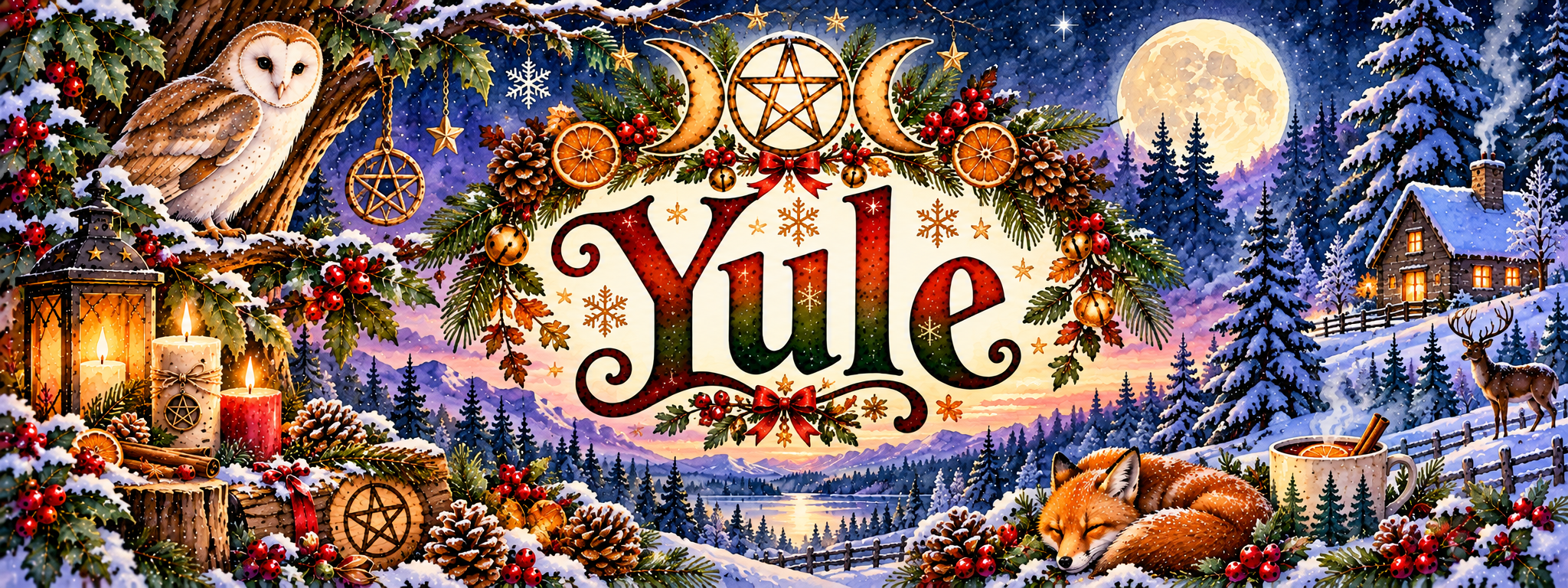
🌲 Yule — The Winter Solstice & the Return of the Light
Discover the History, Nature and Traditions of Yule
Have you ever noticed how winter days grow shorter, the evenings become darker and the natural world seems quieter as December approaches?
For centuries, people have observed the changing seasons, the movement of the Sun and the return of longer days during winter.
Yule is a name associated with historic midwinter celebrations, seasonal traditions and modern Pagan observances.
Today, some people celebrate Yule through candlelight, evergreen decorations, time outdoors and reflection on the changing seasons.
Although different traditions share some similarities, ancient Yule, modern Pagan celebrations and Christmas customs have different histories and meanings.
❄️ What Is Yule?
Yule is a traditional name connected with midwinter festivals among Germanic-speaking peoples, including communities in early medieval northern Europe.
Historical references to Yule appear in Old Norse, Old English and other Germanic languages, although the details of ancient celebrations are not fully known.
In Old Norse, the festival was known as Jól, while related words appeared in Anglo-Saxon England and other Germanic cultures.
Ancient Yule was associated with midwinter gatherings, feasting and seasonal observances, but the exact customs varied across different places and periods.
Historical Yule celebrations could extend across several days, involving feasting, gatherings and seasonal observances, rather than taking place on one fixed day.
Today, Yule is also celebrated by some Pagans, Wiccans and people following nature-based spiritual traditions.
Modern celebrations may focus on the winter solstice, the returning light and the natural cycle of the year.
🌞 What Is the Winter Solstice?
The winter solstice is the moment when the Northern Hemisphere is tilted furthest away from the Sun during Earth's yearly orbit.
It marks the time of the shortest daylight period and longest night of the year in the Northern Hemisphere.
In the UK, the winter solstice usually falls on 21 or 22 December, although the precise date can vary.
In 2026, the winter solstice takes place on Monday 21 December.
After the solstice, the length of daylight gradually increases, although sunrise and sunset times do not change in exactly the same way.
Although the winter solstice marks the shortest day of the year, it is not necessarily the coldest day.
The land, oceans and atmosphere take time to respond to seasonal changes in sunlight, meaning colder weather often arrives later.
The winter solstice is an astronomical event, while Yule is a cultural or religious observance, so the two are connected in some traditions but are not historically identical.
🕯️ Why Is Light Important During Yule?
During winter, the days are shorter, nights are longer and sunlight is less abundant in the Northern Hemisphere.
For many modern Yule celebrants, candles, lanterns and warm lights symbolise the gradual return of longer days.
The returning light may represent hope, renewal and the changing cycle of nature.
Some families mark the solstice by watching the sunrise, lighting a candle safely or spending quiet time together.
For some people, the returning light has a spiritual meaning, while others understand it through seasonal change and astronomy.
These meanings are particularly common in modern seasonal celebrations, although they should not automatically be assumed to describe every ancient Yule tradition.
🌲 Why Are Evergreens Associated with Winter Celebrations?
Evergreen plants such as holly, ivy and fir trees remain green through much of the winter season.
Across different periods, people have used evergreen branches, winter greenery and seasonal decorations in celebrations with different religious and cultural meanings.
Because they retain their leaves or needles, evergreens have become associated with endurance, continuity and life during winter in various traditions.
Some modern Yule celebrations include evergreen wreaths, decorative branches and natural seasonal displays.
However, historians cannot confidently trace every modern evergreen decoration directly back to ancient Yule, because customs developed and changed across many centuries.
Families can explore evergreens by learning about plant adaptations, winter wildlife and the importance of natural habitats.
🔥 What Is a Yule Log?
The Yule log is a traditional winter custom associated with burning a large log during the Christmas and midwinter season.
Historical forms of the custom are recorded in parts of Europe, including Britain, although their origins and meanings varied.
Some households traditionally selected a large piece of wood, placed it on the hearth and allowed it to burn during the festivities.
Although the Yule log is sometimes described as an ancient Pagan tradition, historians cannot confidently establish that every later Christmas log custom developed directly from pre-Christian Yule rituals.
Modern Yule celebrations sometimes reinterpret the custom through decorated wooden logs, candles or symbolic displays.
The familiar chocolate Yule log cake, often called a bûche de Noël, is a French Christmas dessert inspired by the appearance of a wooden log.
Although the names are connected, a chocolate Yule log, a historical hearth tradition and a modern Pagan ritual are not the same practice.
🦌 Was Yule Celebrated by the Vikings?
Historical sources suggest that pre-Christian Scandinavian communities observed a festival called Jól during the midwinter period.
Some medieval texts describe feasting, drinking ceremonies and religious observances connected with the festival.
Some medieval Icelandic accounts describe ceremonial drinking and feasting during Yule, sometimes associated with Norse gods and religious customs.
Because these accounts were recorded after Christianisation, historians must consider when they were written, their intended audiences and how reliably they describe earlier traditions.
Ancient Scandinavian Yule was not necessarily celebrated on the modern astronomical solstice, and its timing may have followed different seasonal calendars.
This means that familiar images of Vikings celebrating Yule on 21 December are often modern interpretations, rather than details firmly established by historical evidence.
🏛️ How Is Yule Connected to Britain?
The history of Yule has connections with early medieval England, where Old English words related to Yule were used for the midwinter period.
The Anglo-Saxon scholar Bede, writing in the eighth century, recorded names for winter months that were connected with the Yule season.
His account provides evidence of early English seasonal terminology, although it does not give us a complete description of ancient celebrations.
The Anglo-Saxon scholar Bede also recorded a midwinter observance called Modranecht, often translated as Mothers' Night.
Although this provides an interesting glimpse into early English traditions, the exact activities and religious meanings associated with the observance are not fully understood.
Over time, Christian traditions, regional customs and changing cultural practices influenced how winter festivals developed in Britain.
Today, people across the UK may explore Yule through modern Pagan gatherings, seasonal activities or personal celebrations of the winter solstice.
🌿 How Is Yule Celebrated Today?
Modern Yule celebrations vary between individuals, families and different spiritual traditions.
Some Pagans and Wiccans observe Yule as part of the Wheel of the Year, a modern framework of eight seasonal festivals.
In this framework, Yule is commonly associated with the winter solstice, the return of longer days and the renewal of seasonal cycles.
Not all Pagan traditions follow the eight-festival Wheel of the Year, and different communities may observe different seasonal celebrations.
Other people celebrate through nature walks, seasonal meals, storytelling or quiet personal reflection.
Some celebrations include rituals, candles, music or decorations made from natural materials.
Not everyone who celebrates Yule follows the same beliefs, the same rituals or the same calendar.
🌍 Is Yule the Same as Christmas?
Although Yule and Christmas share some seasonal customs, they have different religious and historical backgrounds.
Christmas is a Christian festival celebrating the birth of Jesus Christ, while Yule has connections with historic Germanic midwinter observances and modern Pagan traditions.
Some English and Scandinavian words for Christmas developed from older Yule-related terminology, reflecting centuries of cultural and religious change.
Certain customs associated with winter feasting, evergreen decorations and seasonal gatherings appear in different traditions, but their precise origins are not always clear.
It would be inaccurate to say that every Christmas tradition came from Yule or that modern Yule is identical to ancient celebrations.
Today, some families celebrate Christmas, others celebrate Yule, and some enjoy both occasions.
🌙 Why Do People Reflect on the Changing Seasons?
The winter solstice marks an important point in Earth's yearly journey, the seasonal cycle and the changing amount of daylight.
For some people, Yule provides an opportunity to think about the year that has passed, personal experiences and hopes for the months ahead.
Others focus on rest, connection with nature and appreciating the quieter winter season.
These reflections can take place through journalling, creative activities or spending time outdoors.
Although some traditions attach spiritual meanings to the solstice, others enjoy learning about it through science, history and nature observation.
💜 Making Yule Accessible for Everyone
Yule activities can be adapted to suit different sensory preferences, communication styles and individual support needs.
Some children may enjoy soft lighting, natural textures and quiet winter activities, while others prefer movement, music or hands-on exploration.
Families can offer visual choices, predictable activities and opportunities to participate without pressure.
Children who find open flames, strong scents or busy gatherings uncomfortable can explore battery-operated candles, unscented materials or smaller celebrations.
Natural decorations should be chosen carefully because some plants, including holly berries, ivy berries and mistletoe, can be harmful if swallowed.
When using natural decorations, adults should consider choking hazards, plant toxicity and individual sensory or access needs.
Artificial greenery, paper decorations and photographs of winter plants can provide safer alternatives for some children.
Children can participate through watching, listening, touching suitable materials or creating artwork, depending on their preferences.
Meaningful participation does not require speaking, performing rituals or following particular religious beliefs.
✨ Did You Know?
The word Yule is connected with historic Germanic languages, including Old Norse Jól and Old English seasonal terminology.
Historical Yule celebrations could take place over several days, rather than being restricted to one particular date.
The winter solstice marks the shortest daylight period of the year in the Northern Hemisphere.
In 2026, the winter solstice occurs on 21 December, marking the point after which daylight gradually increases in the UK.
The Yule log tradition developed through European winter customs, although its precise origins remain uncertain.
The Anglo-Saxon scholar Bede recorded Modranecht, or Mothers' Night, as part of his account of early English seasonal traditions.
The modern Pagan Wheel of the Year includes eight seasonal festivals, but this complete framework is a modern development rather than an unchanged ancient calendar.
Some languages still use Yule-related words for Christmas, showing how language and traditions change over time.
🌲 Look, Notice and Explore!
You can explore Yule by learning about winter traditions, the changing seasons and the natural world around you.
Try observing the position of the Sun, recording daylight changes or discovering which plants remain green during winter.
You could create an evergreen-inspired collage, decorate a symbolic Yule log or make paper lanterns using battery-operated lights.
Children might enjoy winter storytelling, nature-inspired crafts or simple activities exploring shadows and light.
Remember that Yule can be approached through history, science, culture or personal spiritual traditions, depending on individual interests and beliefs.
Whether you celebrate Yule or simply enjoy learning about it, exploring the winter solstice, seasonal customs and different cultural traditions can help us appreciate the many ways people understand the changing year.